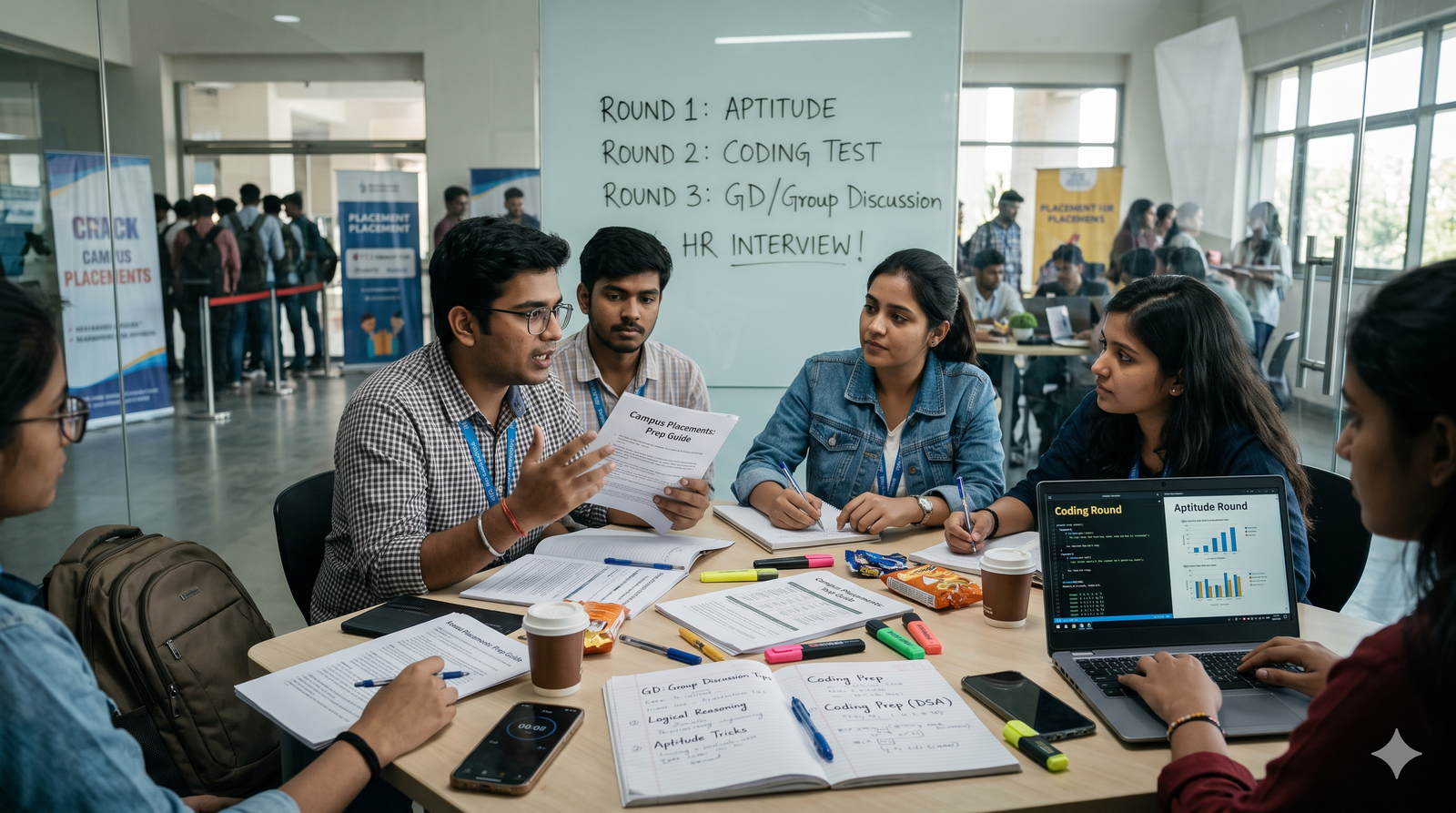
Campus placement season has a strange rhythm. For months nothing seems to happen, and then, within a few weeks, companies visit, tests are scheduled, group discussions are announced and everyone around you seems either confident or panicking. The students who do well are rarely the ones who studied the hardest in the last week. They are the ones who understood early that a campus drive is a series of filters, and prepared for each filter separately.
This guide walks you through every filter: the aptitude test, the coding round, the group discussion and the interviews that follow. You get verified, worked aptitude problems with answers, coding round solutions in Java that we compiled and ran, a GD preparation method with sample topics, and an 8-week plan you can start today. It is written for IT students, final-year students and anyone preparing for campus drives.
|
How to use this guide Solve before you read. Try each aptitude and coding problem yourself first, then compare with the solution. Everything here is checked. We computed every aptitude answer in code and compiled and ran every Java solution, so the answers and outputs are correct. Adapt, do not memorise. Companies change patterns. Learn the methods, not just the questions. Check your own college's rules on eligibility, company categories and offers, because they differ from college to college. |
What This Guide Covers
• How a campus drive works, step by step, and what to prepare before it starts
• Aptitude: strategy, a formula sheet and 12 worked problems with verified answers
• Coding round: format, an input template, a problem-solving loop and 5 solved problems in Java
• Group discussion: how it is judged, a sample timeline, techniques and 3 topic outlines
• Resume, documents, interviews, offer rules, an 8-week plan, common mistakes and FAQs
How a Campus Drive Works
Every company designs its own process, but most IT drives follow a similar staircase. Understanding it tells you where to spend your time.
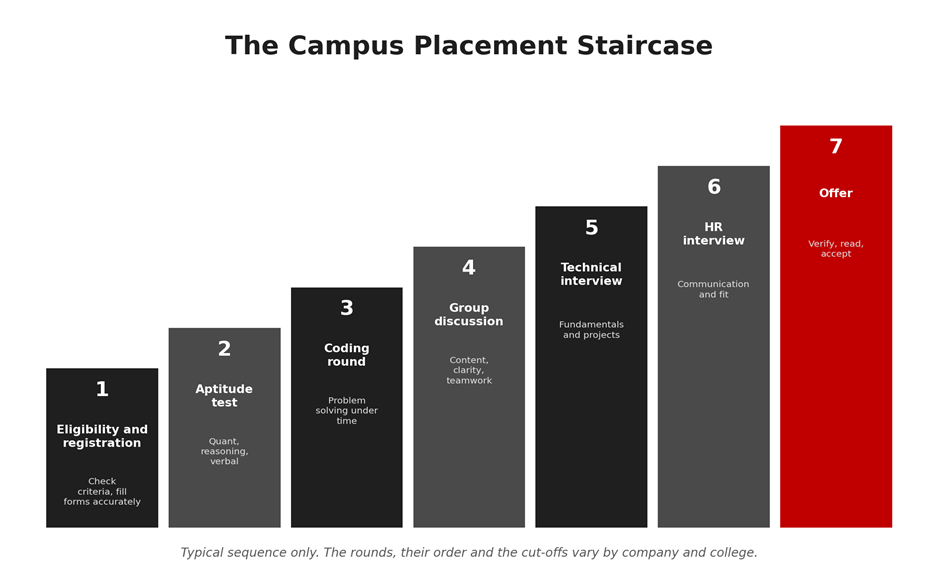
Eligibility and registration. Companies publish criteria such as degree, branch, passing year, marks and backlogs. Students who do not meet them are filtered out before any test. Your placement cell usually collects registrations, so deadlines matter.
Aptitude test. A timed online test covering quantitative aptitude, logical reasoning and verbal ability, sometimes with basic technical questions. It is the largest early filter, because many students are eliminated here.
Coding round. One or more programming problems on an online platform, usually with automated test cases. Some companies combine this with the aptitude test.
Group discussion. Used by some companies to assess communication, structure and teamwork. Not every company runs one.
Technical and HR interviews. The technical round tests fundamentals and projects. The HR round checks communication, attitude and practical fit. See our guides on interview questions and the top Java programs for these rounds.
Offer. Documents are verified and the offer letter follows. Read it carefully before you accept.
Before the Drive: Groundwork That Saves You Later
• Read your college's placement policy. Many colleges classify companies into categories and have rules on how many offers a student can hold. Know the rules before the season, not during it.
• Attend the pre-placement talk and take notes on the roles, selection process, work location, any service agreement and the timeline.
• Fill registration forms with great care. Marks, passing year and backlogs must be exactly right, because a mismatch with your documents can cancel your candidature.
• Prepare a one-page resume with projects, skills and links. Our ATS and resume guides explain the details.
• Keep a document folder ready: photo ID, mark sheets, certificates and passport-size photographs, in both printed and scanned form.
• Set up your test environment: a reliable laptop or lab access, a stable internet connection, a working webcam and a quiet space.
Part 1: Cracking the Aptitude Test
The aptitude test usually decides how many students move on, so it deserves a systematic approach. The good news is that aptitude is the most trainable part of placements. Most of it rests on a limited set of formulas and patterns that you can learn in weeks.
What the test usually covers
• Quantitative aptitude: percentages, ratio and proportion, averages, profit and loss, time and work, speed and distance, interest, permutations and combinations, probability and number series.
• Logical reasoning: series, coding-decoding, blood relations, seating arrangements, syllogisms, directions and data interpretation.
• Verbal ability: reading comprehension, grammar, sentence correction, vocabulary and para-jumbles.
Strategy that works
• Accuracy before speed. If the test has negative marking, a wrong answer costs you. Attempt what you can solve confidently first.
• Do a first pass. Answer the easy questions quickly, mark the harder ones and return to them. Never sink five minutes into one question.
• Respect sectional time limits if the test has them. You may not be able to go back.
• Use approximation. Many options differ widely, so you can round numbers and save time.
• Learn the formulas cold. You cannot waste time deriving them during the test.
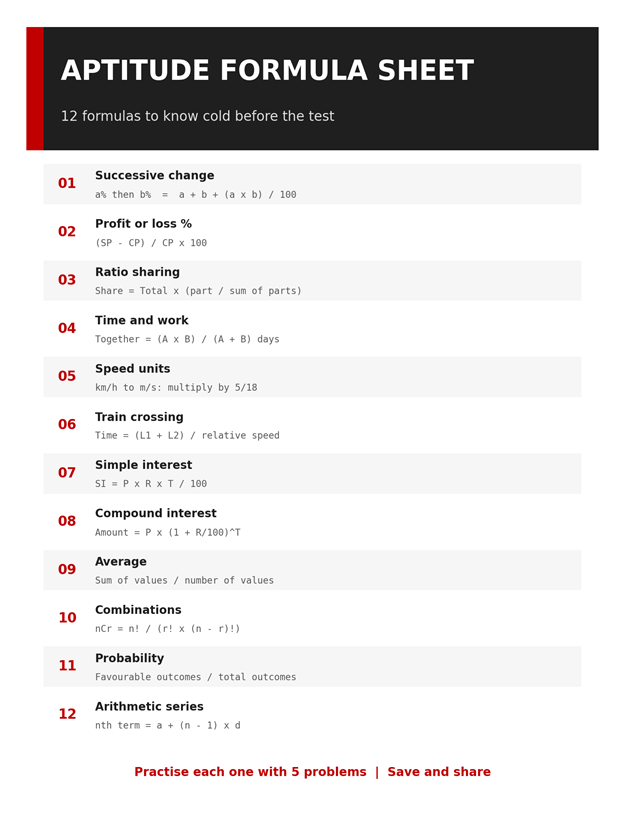
12 Worked Problems With Verified Answers
We computed each of these answers in code. Try each one before reading the solution.
Problem 1. An item priced at ₹2,000 gets a 20% discount, then a further 10% discount. What is the final price?
Solution: After 20% off: 2,000 x 0.80 = 1,600. After a further 10% off: 1,600 x 0.90 = 1,440. The equivalent single discount is 20 + 10 - (20 x 10)/100 = 28%. Answer: ₹1,440
Trap to remember: a 20% increase followed by a 20% decrease does not return you to the start. From 100 you reach 96, a net 4% fall.
Problem 2. Divide ₹7,200 among three people in the ratio 2 : 3 : 4. What does each get?
Solution: Total parts = 2 + 3 + 4 = 9. One part = 7,200 / 9 = 800. The shares are 2 x 800, 3 x 800 and 4 x 800. Answer: ₹1,600, ₹2,400 and ₹3,200
Problem 3. A can finish a job in 12 days and B in 18 days. How long will they take working together?
Solution: Together = (12 x 18) / (12 + 18) = 216 / 30. Answer: 7.2 days
Problem 4. A 150 m long train crosses a pole in 15 seconds. How long will it take to cross a 300 m platform?
Solution: Speed = 150 / 15 = 10 m/s (which is 36 km/h). To cross the platform it must cover 150 + 300 = 450 m, so time = 450 / 10. Answer: 45 seconds
Problem 5. An article costs ₹800. What is the selling price for a 25% profit, and for a 10% loss?
Solution: For 25% profit: 800 x 1.25 = 1,000. For 10% loss: 800 x 0.90 = 720. Answer: ₹1,000 and ₹720
Problem 6. Find the simple interest and compound interest on ₹10,000 at 10% per annum for 2 years.
Solution: SI = 10,000 x 10 x 2 / 100 = 2,000. Compound amount = 10,000 x (1.1)^2 = 12,100, so CI = 2,100. The difference is 100. Answer: SI ₹2,000 and CI ₹2,100
Problem 7. The average of 5 numbers is 24. A sixth number is added and the average becomes 26. What is the sixth number?
Solution: New total = 26 x 6 = 156. Old total = 24 x 5 = 120. Sixth number = 156 - 120. Answer: 36
Problem 8. A boat travels at 12 km/h in still water and the stream flows at 3 km/h. How long does it take to go 45 km downstream and return 45 km upstream?
Solution: Downstream speed = 12 + 3 = 15 km/h, so time = 45 / 15 = 3 hours. Upstream speed = 12 - 3 = 9 km/h, so time = 45 / 9 = 5 hours. Total = 3 + 5. Answer: 8 hours
Problem 9. Find the next number in the series 2, 5, 10, 17, 26, ?
Solution: The differences are 3, 5, 7, 9, which increase by 2 each time, so the next difference is 11. Next term = 26 + 11. Answer: 37
Problem 10. Two fair dice are rolled. What is the probability that the sum is 8?
Solution: Favourable outcomes: (2,6), (3,5), (4,4), (5,3), (6,2), which makes 5. Total outcomes = 6 x 6 = 36. Answer: 5/36
Problem 11. In how many ways can a committee of 3 be chosen from 7 people? And in how many ways can the 6 letters of CAMPUS be arranged?
Solution: Committee: 7C3 = 7! / (3! x 4!) = 35. Arrangements of 6 distinct letters = 6! = 720. Answer: 35 ways and 720 ways
Problem 12. In a certain code, CAT is written as 24. Using the same rule, what is DOG?
Solution: Add the alphabet positions: C(3) + A(1) + T(20) = 24, so the rule is the sum of positions. D(4) + O(15) + G(7) = 26. Answer: 26

A simple aptitude practice routine
• Daily: 30 to 45 minutes of timed practice on one topic, followed by reviewing every mistake.
• Weekly: one full timed mock test, then a written list of the topics where you lost marks.
• Keep a mistake notebook with the question, your error and the correct method. Re-read it before every mock.
• Practise reasoning and verbal as well. Many students over-focus on quant and lose marks elsewhere.
Part 2: Cracking the Coding Round
The coding round filters candidates by problem-solving, not by language trivia. Most platforms run your code against hidden test cases and award marks for each case passed, so a correct simple solution beats an unfinished perfect one.
What to expect
• One to a few problems of easy to medium difficulty, often with a fixed time limit.
• A choice of languages, commonly Java, Python or C++. Use the one you know best.
• Automated checking against sample and hidden test cases, so output format matters exactly.
• Proctoring in many tests: webcam on, no tab switching and no outside help.
• Topics: arrays, strings, hashing, sorting, stacks and queues, recursion, basic searching and simple dynamic programming, plus SQL and core computer science fundamentals in some drives.
Master the input and output first
A surprising number of students lose marks to input handling, not logic. Many platforms read input from the keyboard and compare your printed output character by character. Here is a reliable Java template. With the input 5 followed by 1 2 3 4 5, it prints the sum.
import java.util.Scanner;
public class Main {
public static void main(String[] args) {
Scanner sc = new Scanner(System.in);
int n = sc.nextInt(); // first line: number of elements
int[] numbers = new int[n];
for (int i = 0; i < n; i++) {
numbers[i] = sc.nextInt(); // second line: the elements
}
long sum = 0; // long avoids overflow
for (int value : numbers) {
sum += value;
}
System.out.println(sum);
}
}
Output for the input "5" and "1 2 3 4 5":
15
Tips: print exactly what is asked and nothing else, such as extra labels. Use long for sums that may overflow. For very large inputs, a BufferedReader is faster than Scanner. Always read the sample input and output in the problem statement carefully.
The problem-solving loop
Use the same six steps on every problem. They keep you calm, and they produce partial marks even when you cannot find the best solution.
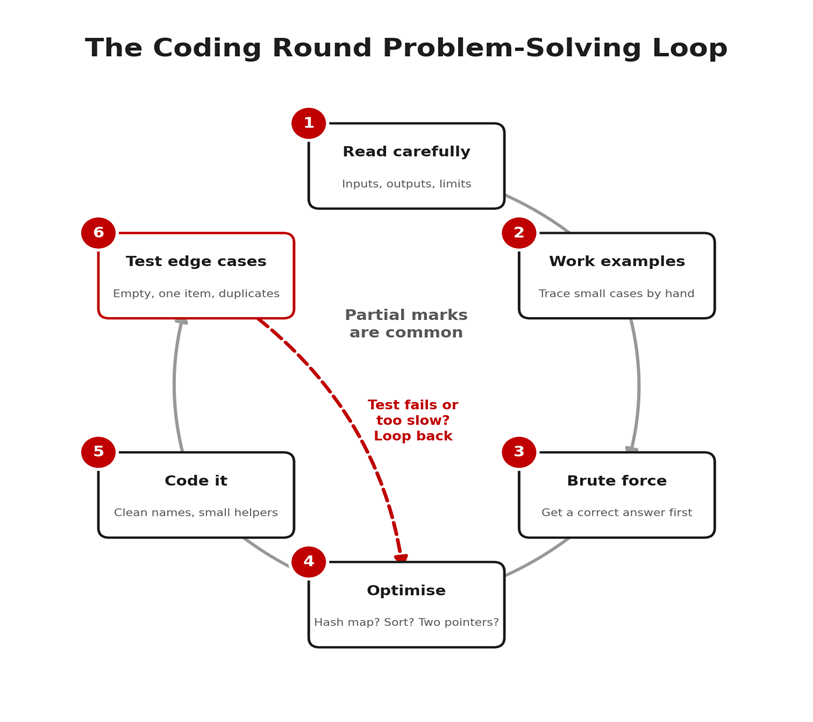
• Read carefully: note the inputs, outputs, constraints and any edge conditions.
• Work examples: trace one or two small cases by hand.
• Brute force first: write down a correct but slow idea. It is your safety net.
• Optimise: ask whether a hash map, sorting or two pointers can speed it up.
• Code it: use clear names and small helper methods.
• Test edge cases: empty input, one element, duplicates, negatives and large values.
Five solved problems
These five patterns cover a large share of fresher-level coding questions. Every solution below was compiled and run, and the output shown is the real output.
Coding Problem 1: Two Sum
Problem: Given an array and a target, return the indices of two numbers that add up to the target.
Approach: Checking every pair is O(n squared). Instead, for each number, look up whether its complement (target minus the number) has already been seen in a HashMap. One pass is enough.
import java.util.Arrays;
import java.util.HashMap;
import java.util.Map;
public class Main {
static int[] twoSum(int[] numbers, int target) {
Map<Integer, Integer> seen = new HashMap<>();
for (int i = 0; i < numbers.length; i++) {
int needed = target - numbers[i];
if (seen.containsKey(needed)) {
return new int[]{seen.get(needed), i};
}
seen.put(numbers[i], i);
}
return new int[]{-1, -1};
}
public static void main(String[] args) {
System.out.println(Arrays.toString(twoSum(new int[]{2, 7, 11, 15}, 9)));
System.out.println(Arrays.toString(twoSum(new int[]{3, 2, 4}, 6)));
System.out.println(Arrays.toString(twoSum(new int[]{1, 2, 3}, 10)));
}
}
Output:
[0, 1]
[1, 2]
[-1, -1]
Complexity: O(n) time and O(n) space.
Edge cases to mention: no valid pair (return a sentinel such as -1), negative numbers and duplicates.
Coding Problem 2: Balanced Parentheses
Problem: Check whether a string of brackets such as ( ) [ ] { } is balanced.
Approach: Use a stack. Push every opening bracket. For every closing bracket, pop the stack and confirm that it matches. At the end, the stack must be empty.
import java.util.ArrayDeque;
import java.util.Deque;
public class Main {
static boolean isBalanced(String text) {
Deque<Character> stack = new ArrayDeque<>();
for (char ch : text.toCharArray()) {
if (ch == '(' || ch == '[' || ch == '{') {
stack.push(ch);
} else if (ch == ')' || ch == ']' || ch == '}') {
if (stack.isEmpty()) return false;
char open = stack.pop();
boolean matches = (ch == ')' && open == '(')
|| (ch == ']' && open == '[')
|| (ch == '}' && open == '{');
if (!matches) return false;
}
}
return stack.isEmpty();
}
public static void main(String[] args) {
String[] tests = {"()[]{}", "(]", "([{}])", "((", ""};
for (String t : tests) {
System.out.println("\"" + t + "\" -> " + isBalanced(t));
}
}
}
Output:
"()[]{}" -> true
"(]" -> false
"([{}])" -> true
"((" -> false
"" -> true
Complexity: O(n) time and O(n) space.
Edge cases to mention: a closing bracket with an empty stack, leftover opening brackets and the empty string.
Coding Problem 3: First Non-Repeating Character
Problem: Return the first character in a string that appears only once.
Approach: Count every character with a LinkedHashMap, which keeps insertion order. Then scan the map and return the first character with a count of 1.
import java.util.LinkedHashMap;
import java.util.Map;
public class Main {
static char firstUniqueChar(String text) {
Map<Character, Integer> count = new LinkedHashMap<>();
for (char ch : text.toCharArray()) {
count.put(ch, count.getOrDefault(ch, 0) + 1);
}
for (Map.Entry<Character, Integer> entry : count.entrySet()) {
if (entry.getValue() == 1) {
return entry.getKey();
}
}
return '-'; // no unique character
}
public static void main(String[] args) {
System.out.println(firstUniqueChar("swiss"));
System.out.println(firstUniqueChar("aabbcd"));
System.out.println(firstUniqueChar("aabb"));
}
}
Output:
w
c
-
Complexity: O(n) time and O(k) space, where k is the number of distinct characters.
Edge cases to mention: no unique character (we return a dash), a single character and mixed case.
Coding Problem 4: Maximum Subarray Sum (Kadane's Algorithm)
Problem: Find the largest sum of any contiguous part of an array.
Approach: Walk through the array while tracking the best sum ending at the current position. At each step, either extend the previous run or start fresh at the current number, whichever is larger. Keep the best result seen.
public class Main {
static int maxSubarraySum(int[] numbers) {
int best = numbers[0];
int current = numbers[0];
for (int i = 1; i < numbers.length; i++) {
current = Math.max(numbers[i], current + numbers[i]);
best = Math.max(best, current);
}
return best;
}
public static void main(String[] args) {
int[] mixed = {-2, 1, -3, 4, -1, 2, 1, -5, 4};
int[] mostlyPositive = {5, 4, -1, 7, 8};
int[] allNegative = {-3, -1, -2};
int[] single = {7};
System.out.println(maxSubarraySum(mixed));
System.out.println(maxSubarraySum(mostlyPositive));
System.out.println(maxSubarraySum(allNegative));
System.out.println(maxSubarraySum(single));
}
}
Output:
6
23
-1
7
Complexity: O(n) time and O(1) space.
Edge cases to mention: all negative numbers (the answer is the largest single element) and a single-element array.
Coding Problem 5: Reverse the Words in a Sentence
Problem: Reverse the order of the words, ignoring extra spaces.
Approach: Trim the sentence and split on one or more spaces. Then build the result from the last word to the first, adding a single space between words.
public class Main {
static String reverseWords(String sentence) {
String[] words = sentence.trim().split("\\s+");
StringBuilder result = new StringBuilder();
for (int i = words.length - 1; i >= 0; i--) {
result.append(words[i]);
if (i > 0) {
result.append(' ');
}
}
return result.toString();
}
public static void main(String[] args) {
System.out.println(reverseWords("campus placement guide"));
System.out.println(reverseWords(" hello world "));
System.out.println(reverseWords("single"));
}
}
Output:
guide placement campus
world hello
single
Complexity: O(n) time and O(n) space.
Edge cases to mention: leading and trailing spaces, multiple spaces between words and a single word.
Partial marks and time strategy
• Solve the easiest problem first to bank marks and settle your nerves.
• Submit a correct brute force if you cannot find the efficient idea. It may pass many test cases.
• Test with your own cases before submitting, especially empty and single-element inputs.
• Do not over-polish. In a timed test, clear and correct beats elegant and late.
• Leave a few minutes at the end to re-read the problem statement and confirm your output format.
Beyond DSA: SQL and CS fundamentals
Many drives also test basics in the written or technical rounds. Revise SQL (joins, GROUP BY, HAVING, subqueries), operating system ideas (process vs thread, deadlock), database concepts (keys, normalisation, ACID), networking basics (HTTP, DNS) and object-oriented programming. Our SQL queries guide and clean code guide cover these.
Part 3: Cracking the Group Discussion
A group discussion looks chaotic from outside, but evaluators are usually watching for a handful of specific things. If you know them, you can prepare for them.
What evaluators typically look for
• Content: do you have relevant, well-reasoned points, not just opinions?
• Structure and clarity: can you make a point in a few clear sentences?
• Communication: voice, language and confidence, without shouting.
• Listening and teamwork: do you build on others' points and include quieter members?
• Leadership and composure: do you keep the discussion on track and stay calm under interruption?
Notice that volume is not on the list. Speaking the most is not the same as scoring the most.
Anatomy of a group discussion
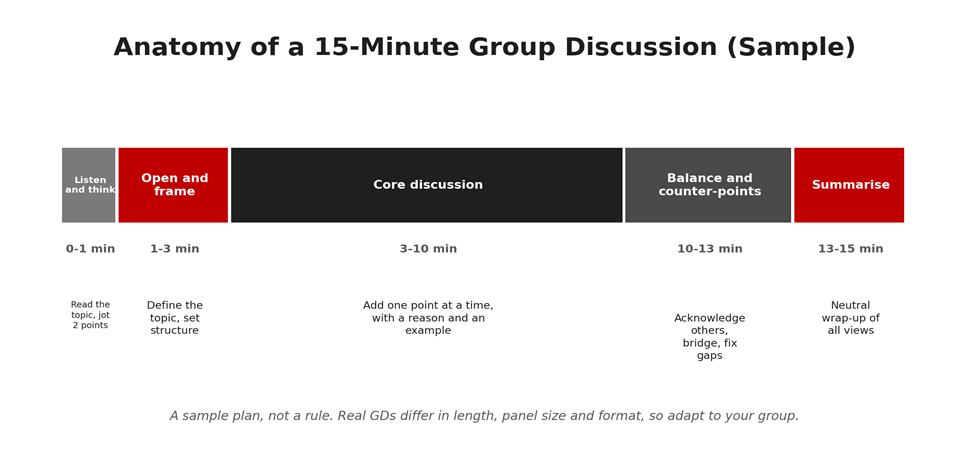
Techniques that work
• Use the first minute to think. Jot two points for and two against before you speak.
• Open with a frame, not an opinion. A definition and a structure give the discussion direction.
• Use PREP: Point, Reason, Example, Point. It keeps every contribution short and complete.
• Bridge to others: "Building on what Rahul said..." shows listening.
• Disagree politely: "I see it differently, because..." beats "You are wrong".
• Include the quiet member: "Meera, what is your view on this?" shows leadership.
• Summarise at the end if the moment arises, neutrally, covering all sides.
|
Useful phrases (adapt to your own words) Opening: "Let me start by defining the topic, and then suggest we look at it from three angles: benefits, risks and the way forward." Adding a point: "One more angle we have not covered is..." Interrupting politely: "May I add a quick point here?" Redirecting: "We seem to be moving away from the topic. Shall we return to the main question?" Summarising: "To sum up, the group has discussed ... On balance, ..." |
Three sample topics with outlines
These are outlines to think with, not scripts. Do not quote statistics unless you are sure of them.
Topic 1: "AI will replace entry-level IT jobs."
• Frame: define entry-level work and what AI tools can currently do.
• For: routine, repetitive tasks such as simple code, testing and support are the easiest to automate.
• Against: new roles appear, people are still needed to design, review and take responsibility, and AI output needs checking.
• Balanced close: the work changes more than it disappears, so skills, adaptability and fundamentals matter most.
Topic 2: "Work from office is better than work from home for freshers."
• Frame: consider freshers specifically, since they are still learning.
• Office: easier mentoring, quick doubts, team culture and visibility.
• Home: flexibility, saved commute time and wider job access.
• Balanced close: a hybrid arrangement with structured mentoring in the early months can combine both.
Topic 3: "A degree is no longer necessary for a tech career."
• Frame: separate "learning the skills" from "being considered for the job".
• For: projects, certifications and open learning resources let people prove skills without a degree.
• Against: many employers use degrees as eligibility filters, and degrees build fundamentals and discipline.
• Balanced close: the degree opens doors, and skills decide how far you go.
Common GD mistakes
• Speaking first with no structure just to be noticed.
• Interrupting, or talking over others.
• Repeating the same point louder.
• Going silent. Even two good contributions are better than none.
• Quoting statistics you cannot verify.
• Becoming personal or aggressive in disagreements.
How to practise GD
1. Form a group of 6 to 8 friends and practise two topics a week.
2. Appoint one person as an observer who notes who spoke, who listened and who summarised.
3. Record a session and watch yourself. Check your pace, filler words and body language.
4. Read one good article daily on technology, business or society to build content.
5. Give each other feedback on one strength and one improvement.
After the Rounds: Interviews, Resume and Offers
Clearing the written rounds only gets you to the interview. Prepare your projects so that you can explain every line of your resume, revise fundamentals (OOP, SQL, data structures, operating systems and networking) and practise your HR answers aloud. Our guides on Pune interview questions, top Java programs and clean code give you ready material for this stage.
Resume for campus drives
• Keep it to one page with a clear summary, skills, projects, education and relevant certifications.
• Make sure every detail matches your documents exactly, including marks and dates.
• Describe projects with the tools you used and what you personally did.
• Include GitHub and LinkedIn links that actually work.
On the day of the drive
• Arrive early and carry your documents, ID, resume copies and a pen.
• Dress neatly in clean, simple, formal clothes.
• Switch off distractions. Keep your phone silent and charged for emergencies only.
• Stay professional while waiting. Placement teams and recruiters notice behaviour.
• For online tests, log in early, check your camera, microphone and internet, and read all rules.
• Eat and sleep properly before the day. A tired mind makes silly errors.
Offers and college rules
Read the offer letter carefully: role, location, joining date, compensation structure, probation and any service agreement. Check your college's policy on holding or declining offers before you respond, and never accept an offer you are not prepared to honour. If you are not selected, ask for feedback where possible and move to off-campus options without delay. Our guide to off-campus placements explains how.
Your 8-Week Campus Placement Plan
Study one to three hours a day, adjusted to your college schedule. The plan builds from foundations to full mock tests.
• Week 1, baseline: take one timed aptitude mock and one coding test, list your weak topics, fix your resume and set your daily routine.
• Week 2: percentages, ratio, averages and profit and loss, plus array and string problems.
• Week 3: time and work, speed and distance, interest, plus hashing and sorting problems. Begin daily reading for GD content.
• Week 4: reasoning (series, coding-decoding, seating, syllogisms), plus stacks, queues and recursion. Hold your first group discussion practice.
• Week 5: verbal ability, SQL and core CS fundamentals, and timed sectional tests.
• Week 6: two full-length mock tests, a detailed mistake review, and two GD practices.
• Week 7: technical and HR interview practice, project explanations and mock interviews.
• Week 8: light revision, weak-topic fixes, logistics and rest. Do not cram.
Common Mistakes in Campus Placements
• Starting too late. Aptitude and coding skills need weeks, not days.
• Ignoring aptitude because it feels "non-technical". It decides who reaches the technical rounds.
• Practising problems without timing yourself.
• Memorising solutions instead of learning patterns.
• Skipping GD practice and hoping to improvise.
• Incorrect registration details, which can cancel a candidature.
• Comparing yourself with classmates instead of tracking your own progress.
• Believing one rejection is final. Many placed students were rejected at least once first.
Your Pre-Drive Checklist
• I know the company's eligibility criteria, and my registration details are accurate.
• I have learned the 12 aptitude formulas and practised timed sets.
• I can solve basic array, string and hashing problems and read input correctly.
• I have done at least two full mock tests.
• I have practised group discussions with feedback.
• I can explain every project on my resume.
• My documents, resume copies and test setup are ready.
• I have read my college's placement and offer policy.
Where Structured Guidance Can Help
Campus preparation is easier with feedback, such as timed mock tests, a code review or a GD observer. If you would like guided support, a learning centre such as upGrad Learning Support Centre, Pune can be a useful next step to explore, especially if you want structured practice, project work and interview preparation.
Structured programmes in areas like data, AI/ML, full stack development and digital marketing generally combine a planned curriculum, hands-on projects, mentor guidance and interview preparation. Course content, fees, schedules and eligibility can change, so confirm the latest details directly with the centre.
Before joining any programme, ask whether you will build real projects and get feedback on them, whether mock tests and mock interviews are included, and whether the curriculum matches what employers ask for today. Be cautious about anyone who guarantees a job, interviews or a salary, because nobody can honestly promise that.
Get Regular Job Updates
Looking for regular IT job updates, fresher opportunities, and career-related updates? Join our WhatsApp group for more job updates and opportunities.
Join our WhatsApp Group: https://chat.whatsapp.com/KA8HpgjbJ67I5yfQDquCvn
Frequently Asked Questions (FAQs)
Q. How long does it take to prepare for campus placements?
It varies, but most students need several weeks of regular practice for aptitude and coding. An 8-week plan like the one above is a realistic structure, and starting earlier is better.
Q. Which topics are most important in aptitude tests?
Percentages, ratio, averages, profit and loss, time and work, speed and distance, interest, series and basic probability appear very often. Reasoning and verbal sections are also commonly included, so cover all three areas.
Q. Which programming language should I use in coding rounds?
Use the language you know best from those the platform allows, commonly Java, Python or C++. Fluency and correctness matter more than the language.
Q. What if I cannot solve a coding problem completely?
Submit a correct brute force solution. Many platforms award marks per passed test case, so a partial solution can still score.
Q. Is group discussion compulsory in campus drives?
No. Some companies include it and many do not. If your target companies use it, prepare. The skills help in interviews as well.
Q. How do I speak in a GD if I am shy?
Prepare two clear points before you speak, use the PREP structure and aim for two or three good contributions rather than constant talking. Practise with friends first.
Q. What if my college has no good companies visiting?
Prepare as you would for campus and apply off-campus too. Our off-campus guide explains how to find openings, use referrals and avoid scams.
Q. Can I sit for off-campus drives after receiving a campus offer?
It depends on your college's policy and the company's terms. Check with your placement cell before you apply, and never accept an offer you are not ready to honour.
Conclusion
Learning how to crack campus placements is mostly about respecting each filter on its own terms: formulas and timed practice for aptitude, patterns and clean test-driven solutions for coding, structure and teamwork for the group discussion, and honest preparation for the interviews. None of this needs special talent. It needs a plan, honest feedback and consistent weeks of practice.
Your next step is simple. Take a timed aptitude mock and one coding test this week, list your weak topics and start the 8-week plan. If you want mentor feedback and structured practice, you can also explore what upGrad Learning Support Centre, Pune offers for your chosen path.
And if you want regular job and fresher opportunity updates, use the WhatsApp group link in the "Get Regular Job Updates" section above.