
A Complete Guide for Students and Freshers
Introduction
Choosing the right programming language is one of the most critical decisions for any student or fresher aiming to build an IT career in 2026. The technology industry is evolving rapidly, heavily influenced by cloud computing, data analytics, and the widespread integration of Artificial Intelligence (AI).
While it might seem like new languages and frameworks appear every month, employers still prioritize candidates who have deeply mastered a core programming language. Instead of trying to learn every syntax, successful candidates choose a language that aligns with their target career role—whether that is software development, data science, or full-stack web development.
This guide breaks down the top 10 programming languages that are most in-demand in 2026. We will explore what each language is used for, why it matters today, and how you can structure a realistic learning roadmap to become job-ready without getting overwhelmed.
Quick Answer: Which Programming Languages Matter Most in 2026?
If you are looking for a quick breakdown, here are the top 10 languages and the primary entry-level roles they support:
|
Rank |
Programming Language |
Best Suited For (Primary Roles) |
|
1 |
Python |
Data Science, AI/ML, Backend, Automation |
|
2 |
JavaScript |
Frontend, Full Stack Web Development |
|
3 |
SQL |
Data Analytics, Database Management (All Roles) |
|
4 |
Java |
Enterprise Software, Backend, Android |
|
5 |
TypeScript |
Scalable Web Development, Large Applications |
|
6 |
Go (Golang) |
Cloud Infrastructure, Microservices |
|
7 |
C++ |
Performance Systems, Game Engine Development |
|
8 |
C# |
Enterprise Apps (.NET), Game Development (Unity) |
|
9 |
Rust |
High-Performance Systems, Secure Computing |
|
10 |
Kotlin |
Modern Android Mobile App Development |
Why Language Choice is Changing in 2026
In the past, being a generalist who knew a little bit of C, Java, and PHP was often enough to secure a fresher role. In 2026, companies want specialists who understand the ecosystem surrounding a language.
Furthermore, Generative AI tools can now write basic code in almost any language. As a result, employers evaluate freshers based on their ability to solve complex problems, design clean logic, and debug effectively in one or two primary languages, rather than their ability to write "Hello World" in ten.
Top 10 Programming Languages Freshers Should Learn in 2026
1. Python
Python continues to dominate the IT industry in 2026. Its readable, beginner-friendly syntax makes it the perfect first language. More importantly, it is the absolute foundation for Data Science, Artificial Intelligence, and Machine Learning. If you want to work with LLMs, build data pipelines, or automate tasks, Python is non-negotiable.
2. JavaScript
JavaScript is the undisputed king of the web. Every modern web application relies on it. For freshers interested in building interactive user interfaces or becoming Full Stack Developers (using Node.js on the backend), mastering JavaScript is critical. It offers the fastest route to building visible, portfolio-ready projects.
3. SQL
While technically a database query language rather than a general-purpose programming language, SQL is universally required. Whether you are a backend Java developer, a Python data analyst, or a cloud engineer, you will need to extract and manipulate data. Knowing how to write complex JOINs and optimize queries is a massive advantage in any interview.
4. Java
Despite the rise of newer languages, Java remains the backbone of enterprise software development. Large banks, multinational corporations, and legacy systems rely heavily on Java (and frameworks like Spring Boot). It is an excellent choice for students who want stable corporate roles and a deep understanding of Object-Oriented Programming (OOP).
5. TypeScript
Think of TypeScript as JavaScript with superpowers. It adds "static typing" to JavaScript, which helps catch errors before the code is even run. In 2026, most serious frontend frameworks and large-scale web applications have moved to TypeScript. Learning JavaScript first and then graduating to TypeScript is highly recommended for web developers.
6. Go (Golang)
Developed by Google, Go has seen massive growth for backend and cloud engineering. It is designed to be simple, fast, and excellent at handling multiple tasks simultaneously (concurrency). As companies move entirely to cloud-native microservices, Go has become a highly sought-after skill for modern infrastructure roles.
7. C++
C++ is not for the faint of heart, but it is essential where performance is the top priority. It is heavily used in game development (Unreal Engine), high-frequency financial trading systems, and embedded hardware. It teaches you how memory actually works in a computer, giving you a deep computer science foundation.
8. C#
Developed by Microsoft, C# is widely used for building enterprise applications within the .NET ecosystem. It is also the primary language for the Unity game engine. If you want to develop Windows applications, work in enterprise software, or build 2D/3D games, C# is an excellent, highly employable choice.
9. Rust
Rust is one of the most loved programming languages in the world because it solves a huge problem: memory safety. It prevents many common bugs that crash systems or cause security vulnerabilities. While it has a steeper learning curve, learning Rust positions you for high-end systems programming roles in 2026.
10. Kotlin
If you want to build Android applications, Kotlin is the modern standard. Google officially prefers Kotlin over Java for Android development. It is concise, safe, and fully interoperable with existing Java code, making it an essential skill for aspiring mobile app developers.
Language Priority Guide for Freshers
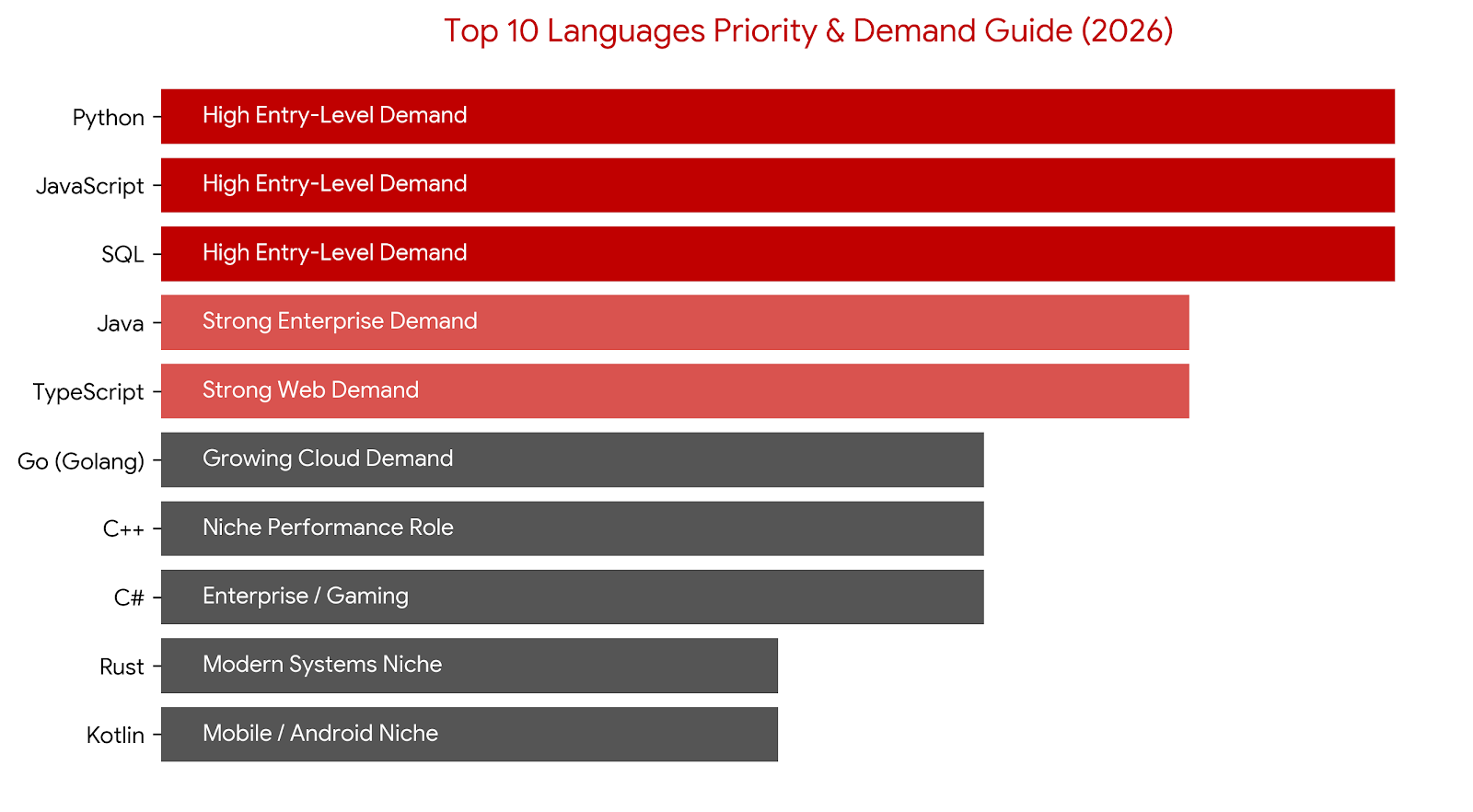
Not all languages have the same entry-level demand. The chart below illustrates which languages should be prioritized for a smoother transition into your first IT job.
How to Choose Your First Language
Do not select a language randomly. Match it to your career goals:
· Web Development: Start with JavaScript, then learn TypeScript.
· Data, AI & Automation: Focus entirely on Python and SQL.
· Corporate Software Engineering: Java or C# (.NET) is the safest bet.
· Systems & Cloud: Explore Go, C++, or Rust.
Do Freshers Need to Learn Multiple Languages?
No. Trying to learn Python, Java, and C++ at the same time is the fastest way to fail. The logic of programming (loops, conditions, object-oriented principles, data structures) transfers easily between languages.
A practical approach is "T-shaped learning": build deep, practical expertise in ONE core language (the vertical stem of the T), and have a broad, basic awareness of related tools like SQL and Git (the horizontal bar).
6-Month Programming Skills Roadmap for Freshers
To ensure you become job-ready, follow this structured roadmap to mastering your chosen language:
Month 1 — Direction & Fundamentals: Choose ONE primary language. Focus on syntax, variables, loops, conditional statements, and basic problem-solving.
Month 2 — Core Skills: Dive deeply into Object-Oriented Programming (OOP) or functional programming, error handling, and basic Data Structures and Algorithms (DSA).
Month 3 — Tools & Practice: Learn SQL and Git simultaneously. Start solving coding challenges daily to build your logical thinking abilities.
Month 4 — Projects: Build 1–2 practical, real-world projects without copying tutorials line-by-line. Integrate a database using SQL.
Month 5 — Profile & Interviews: Upload your projects to GitHub, polish your resume, and start mock technical interviews focusing on your chosen language.
Month 6 — Applications & Improvement: Apply consistently, attend interviews, analyze the technical questions you struggle with, and refine your skills.
The timeline is flexible. Students with prior technical knowledge may move faster, while beginners may need more time for fundamentals.
Why Projects Matter More Than Syntax
Employers in 2026 care less about whether you have memorized syntax and more about whether you can build systems. A project proves that you can integrate your programming language with databases, user interfaces, and APIs.
Project Ideas by Language:
· Python: A data analysis dashboard using Pandas or an AI-integrated chat application using OpenAI's API.
· JavaScript: A fully responsive e-commerce storefront or a dynamic task-management web app.
· Java: A robust backend system for a library management tool or a scalable banking API prototype.
Ensure your projects are well-documented on GitHub so recruiters can read your code easily.
How upGrad Learning Support Centre Pune Can Help
Mastering a programming language on your own requires immense discipline, and many students struggle to move from basic syntax to building complex projects. For those who prefer a structured, instructor-led learning environment, upGrad Learning Support Centre Pune is an excellent option to explore.
The centre currently offers comprehensive, classroom-based programs across high-demand areas—including Full Stack Development, Data Science, Data Analytics, and Generative AI. With locations currently in Kothrud and Wakad, the programs are designed to help freshers build practical coding skills systematically.
Key features of learning through the centre include:
· Instructor-led classroom learning for better engagement and focus.
· 1:1 mentorship to resolve coding doubts and provide career direction.
· Guided and live projects to build a strong, interview-ready portfolio.
· Industry-led sessions to understand real-world corporate expectations.
· Dedicated career support, including interview prep and profile building.
By leveraging upGrad's 5Ps learning methodology—focused on preparation, understanding, practice, problem-solving, and projects—students can bridge the gap between academic knowledge and industry readiness. Always review the latest program details and eligibility directly before enrolling.
Common Mistakes Freshers Should Avoid
· Language Hopping: Switching to a new language every two weeks and mastering none.
· Tutorial Hell: Watching hours of coding videos without typing a single line of code yourself.
· Ignoring Core Computer Science: Skipping Data Structures and Algorithms (DSA) entirely.
· Relying on AI blindly: Copy-pasting ChatGPT solutions without understanding why the code works.
Fresher Programming Readiness Checklist
Use this simple checklist to track your coding readiness:
|
Preparation Area |
Goal / Milestone |
|
Core Syntax |
I can confidently write functions, loops, and conditions without help. |
|
DSA Basics |
I understand arrays, lists, strings, and basic sorting algorithms. |
|
OOP / Logic |
I understand how to structure larger programs clearly. |
|
Database / SQL |
I can connect my code to a database and retrieve data. |
|
Version Control |
I can commit my code to GitHub and manage a repository. |
|
Projects |
I have built at least 2 complete projects from scratch. |
Frequently Asked Questions
Which programming language is best for freshers in 2026?
Python and JavaScript are the two most recommended starting points. Python is best for data and backend, while JavaScript is essential for frontend and full-stack web development.
Is Java still relevant in 2026?
Yes, absolutely. Java remains the top choice for large enterprise applications, banking systems, and Android development. It is highly stable for freshers seeking corporate roles.
Do I need to learn SQL if I know Python?
Yes. Python helps you analyze data, but SQL is required to extract that data from the company's database in the first place.
Should I learn C++ as my first language?
C++ is a powerful language that teaches excellent fundamentals, but it has a steep learning curve. If you want to build games or high-performance systems, yes. Otherwise, Python or Java might be an easier starting point.
Is it enough to just know HTML and CSS?
No. HTML and CSS are markup and styling languages, not programming languages. You must add JavaScript to become an employable web developer.
Conclusion
Securing an IT career in 2026 is not about how many languages you can list on a resume; it is about how deeply you understand one. Whether you choose Python for AI and Data, JavaScript for modern web development, or Java for enterprise systems, consistency is the key to success.
Select a language, stick to the 6-month roadmap, build tangible projects, and do not forget to master SQL and Git along the way. If you need a structured environment in Pune to help you achieve these coding goals, exploring options like upGrad Learning Support Centre Pune can provide the mentorship and practical exposure you need to build a successful career.