
A Complete Guide for Students and Graduates in 2026
Introduction
Graduating with a degree in computer science, BCA, or MCA is an excellent first step, but the 2026 job market requires more than academic knowledge. Freshers often find themselves overwhelmed by the sheer number of technologies available—from React and Python to Cloud and Artificial Intelligence.
To bridge the gap between college education and industry expectations, taking a specialized IT course can be a game-changer. A structured course provides focus, practical projects, and a clear learning roadmap, saving you months of confusion.
This article explores the top 7 IT courses that are highly relevant in 2026. Whether you want to build websites, analyze business data, or work with the latest AI tools, choosing the right course will significantly improve your chances of becoming job-ready.
Quick Answer: Which IT Courses Matter Most in 2026?
If you want a quick overview to help you decide your path, here are the top 7 courses and the types of students they suit best:
|
Course Name |
Best Suited For |
Target Career Role |
|
Full Stack Web Development |
Students who enjoy building visual applications and coding logic. |
Software Developer, Full Stack Engineer |
|
Data Science & Machine Learning |
Students who love mathematics, Python, and predictive models. |
Data Scientist, ML Engineer |
|
Data Analytics & BI |
Students who prefer working with dashboards, Excel, and SQL. |
Data Analyst, BI Developer |
|
Cloud Computing & DevOps |
Students interested in servers, deployment, and infrastructure. |
Cloud Engineer, DevOps Trainee |
|
Generative AI & Prompting |
Students wanting to leverage AI for modern business solutions. |
AI Prompt Engineer, AI Consultant |
|
Cybersecurity Fundamentals |
Students interested in networking, safety, and ethical hacking. |
Security Analyst, Network Engineer |
|
Software Testing & Automation |
Students who have a strong eye for detail and quality assurance. |
QA Automation Engineer |
Why Specialized Courses Matter in 2026
The corporate world has shifted its hiring strategy. Rather than hiring "general computer science graduates," companies are specifically looking for candidates who can contribute to a project from day one.
A specialized course ensures you learn the exact technology stack used in modern businesses, giving you practical experience through guided projects. It teaches you how to combine different tools—like using SQL with Python, or React with Node.js—which is exactly what happens in a real job environment.
Top 7 IT Courses Freshers Should Consider in 2026
1. Full Stack Web Development
A Full Stack Development course teaches you how to build complete web applications from start to finish. You will learn frontend technologies like HTML, CSS, JavaScript, and React, alongside backend tools like Node.js or Java, and databases like MongoDB or MySQL. This course is highly recommended because it opens up the maximum number of entry-level software engineering roles.
2. Data Science & Machine Learning
Data Science is the backbone of intelligent decision-making. This course will cover Python, statistics, data manipulation (Pandas), and Machine Learning algorithms. While it is a challenging path, it is incredibly rewarding. Freshers who complete a Data Science course often find high-paying opportunities in finance, healthcare, and tech companies.
3. Data Analytics & Business Intelligence (BI)
If Data Science feels too mathematically heavy, Data Analytics is the perfect alternative. This course focuses on interpreting existing data to help businesses make decisions. You will master Excel, SQL, and visualization tools like Power BI or Tableau. It is one of the most accessible IT fields for students coming from non-IT or business backgrounds.
4. Generative AI & Prompt Engineering
In 2026, AI is a mandatory skill. A specialized course in Generative AI will not necessarily teach you how to build a Large Language Model from scratch, but rather how to use them effectively. You will learn prompt engineering, API integration, and how to build AI-powered tools that boost business productivity. This is an excellent complementary course to add to any technical profile.
5. Cloud Computing & DevOps
Almost every modern application is hosted on the cloud. A Cloud Computing and DevOps course will teach you the fundamentals of AWS, Azure, or Google Cloud. You will learn about Linux, server management, Docker containers, and CI/CD pipelines. This is ideal for students who prefer infrastructure and deployment over writing thousands of lines of frontend code.
6. Cybersecurity Fundamentals
With the rise of digital transactions, cybersecurity is more critical than ever. A course in this field will teach you about network security, ethical hacking, vulnerability assessment, and data protection. Entry-level roles often include monitoring systems and ensuring that company data remains secure against external threats.
7. Software Testing & Automation
Software must be tested rigorously before it reaches the customer. A Software Testing course covers both manual testing concepts and automation tools like Selenium. It is a highly structured role that requires a keen eye for finding bugs and ensuring quality. Automation testing, utilizing Python or Java, is currently seeing massive demand for freshers.
Course Demand & Priority Guide for Freshers
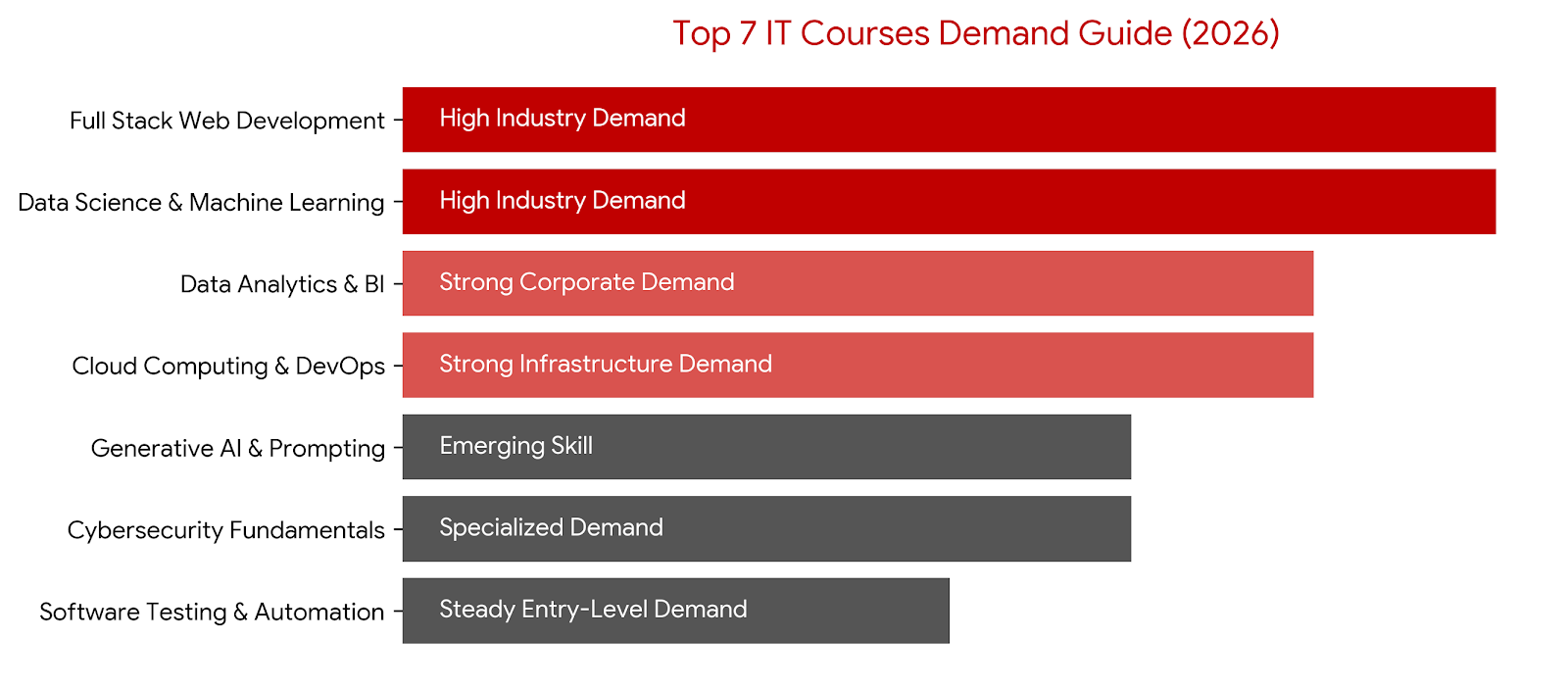
When selecting a course, consider the current industry demand. The chart below illustrates the relative priority and hiring trends for these specializations in 2026.
How to Choose the Right Course
Do not select a course just because you heard it pays well. Match the curriculum to your natural strengths:
· If you are creative and logical, choose Full Stack Development.
· If you love numbers and patterns, choose Data Science or Analytics.
· If you enjoy operations and fixing systems, choose Cloud/DevOps.
· If you want to stay ahead of the curve, integrate Generative AI into your learning.
Do Freshers Need to Learn Everything?
No. Trying to take a Python course, a Cloud course, and a Cybersecurity course at the same time is a mistake. Focus on "T-shaped learning": build deep, job-ready expertise in ONE specific domain (like Full Stack Development), while maintaining a basic awareness of related tools like SQL and AI.
6-Month Course & Learning Roadmap for Freshers
If you enroll in an IT course, here is how your 6-month journey should look to ensure you become truly job-ready:
Month 1 — Direction & Fundamentals: Select your course and focus entirely on the core basics (e.g., core programming, basic SQL, or math foundations).
Month 2 — Core Skills: Dive into the main technologies of your chosen path (e.g., React, Python, or AWS basics).
Month 3 — Tools & Practice: Learn supporting tools like Git/GitHub and start solving practical exercises daily.
Month 4 — Projects: Build 1–2 practical, real-world projects that combine all the skills you have learned so far.
Month 5 — Profile & Interviews: Finalize your portfolio, polish your resume, and begin rigorous mock interviews.
Month 6 — Applications & Improvement: Apply consistently to target roles, review feedback from interviews, and refine your technical knowledge.
The timeline is flexible. Students with prior technical knowledge may move faster, while beginners may need more time for fundamentals.
Why Projects Matter More Than Just Course Certificates
A certificate proves you attended the classes, but projects prove you can do the work. Employers in 2026 want to see tangible evidence. When you complete a course, ensure you have built a portfolio piece—whether that is a functioning e-commerce website, a dynamic sales dashboard, or a deployed cloud environment. Host your code on GitHub and explain your thought process clearly.
How upGrad Learning Support Centre Pune Can Help
While online tutorials are abundant, many students struggle with consistency and lack the industry guidance needed to bridge the gap between theory and practice. For students who prefer a structured, instructor-led environment, upGrad Learning Support Centre Pune offers robust programs to help freshers become job-ready.
The centre currently provides comprehensive, classroom-based courses in high-demand fields like Full Stack Development, Data Science, Data Analytics, Generative AI, and Agentic AI. With easily accessible locations in Kothrud and Wakad, the programs are designed to provide a professional learning atmosphere.
Key features of learning through the centre include:
· Instructor-led classroom learning to ensure deep understanding.
· 1:1 mentorship and doubt resolution from industry experts.
· Guided and live projects to build a strong, interview-ready portfolio.
· Industry-led masterclasses to understand real corporate expectations.
· Dedicated career support, helping with resume building and mock interviews.
By utilizing upGrad's proven 5Ps learning methodology—Preparation, Understanding, Practice, Problem-solving, and Projects—students can effectively transition from academics to the IT industry. Always check the latest program curriculum, eligibility, and schedules directly before enrolling.
Common Mistakes Freshers Should Avoid
· Enrolling in multiple courses at once and finishing none.
· Watching course videos like a movie without practicing the code.
· Relying on AI to complete course assignments without understanding the logic.
· Skipping the project phase and only focusing on the final certificate.
· Applying for jobs with a generic resume that does not highlight course projects.
Fresher Course Readiness Checklist
Before applying for jobs after your course, ensure you meet these milestones:
|
Preparation Area |
Goal / Milestone |
|
Core Concepts |
I understand the foundational logic taught in my chosen course. |
|
Practical Ability |
I can build and run applications/queries without a step-by-step tutorial. |
|
Portfolio / GitHub |
My course projects are uploaded, formatted, and clearly explained. |
|
Resume Alignment |
My resume highlights the specific tools learned in the course. |
|
Interview Practice |
I have practiced technical questions related to my course topics. |
Frequently Asked Questions
Which IT course is best for freshers in 2026?
Full Stack Development and Data Analytics are excellent starting points. They offer the most entry-level opportunities and provide clear, structured career paths.
Do I need a technical degree to take an IT course?
Not always. Courses like Data Analytics or UI/UX are highly accessible for non-IT graduates. However, roles like Data Science or Software Development may require a stronger mathematical or logical background.
Is it necessary to learn Generative AI?
While you don't need to be an AI engineer, taking a short course or module on Generative AI and prompt engineering is highly recommended to improve your productivity in any IT role.
How long does a good IT course take?
A comprehensive, job-oriented course usually takes between 4 to 6 months to complete, allowing enough time for fundamentals, advanced topics, and project building.
Can a course guarantee a job?
No course can guarantee a job. A course provides the skills, portfolio, and support, but your performance in interviews and your ability to apply the knowledge will secure the job.
Conclusion
Choosing the right IT course in 2026 is one of the most important steps you can take to launch your career. Whether you lean towards the visual logic of Full Stack Development, the insights of Data Analytics, or the cutting-edge potential of Generative AI, focus on mastering one specific area.
Remember to prioritize projects over certificates and practice consistently. If you are looking for a structured, professional environment in Pune, considering upGrad Learning Support Centre Pune can give you the instructor-led guidance and career support needed to confidently step into the tech industry.