A Complete Guide to Passing the Final Hiring Hurdle
The Reality of 2026 Tech Interviews
Securing a technical interview in 2026 is an achievement in itself, but passing it requires an entirely different skill set. Recent industry data shows that over 70% of fresher interview rejections are not caused by a lack of coding ability, but rather by entirely avoidable behavioral and process mistakes.
The technical interview is no longer just a coding exam. Hiring managers are evaluating your communication, your ownership of past projects, your virtual presence, and your ability to think critically when you don't know the exact answer. Below are the 7 most critical mistakes freshers make—and exactly how you can avoid them.
Why Freshers Fail Technical Interviews
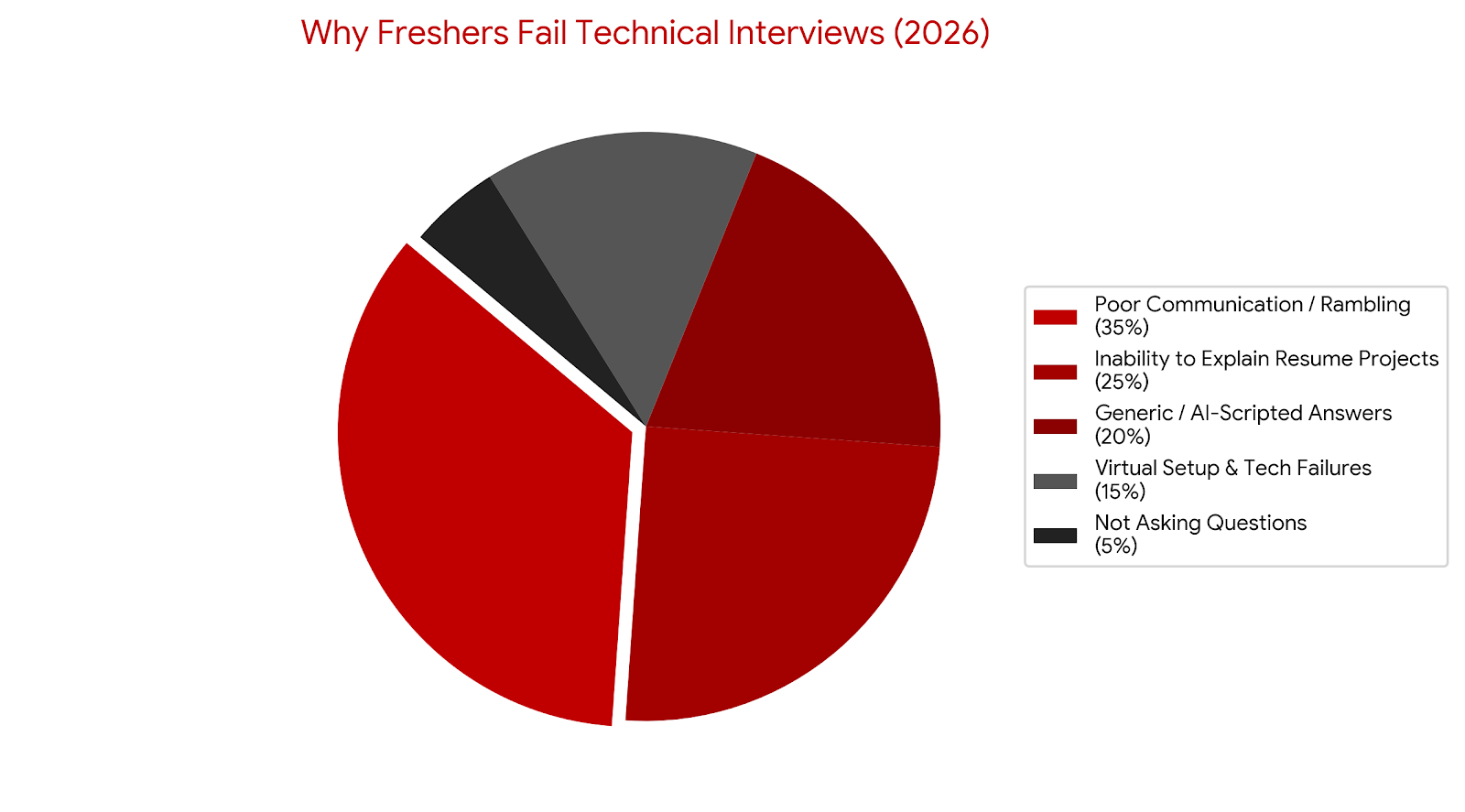
Understanding the common pitfalls can help you structure your preparation. The pie chart below illustrates the primary reasons candidates face rejection after reaching the interview stage.
Recruiter Expectations & Success Factors
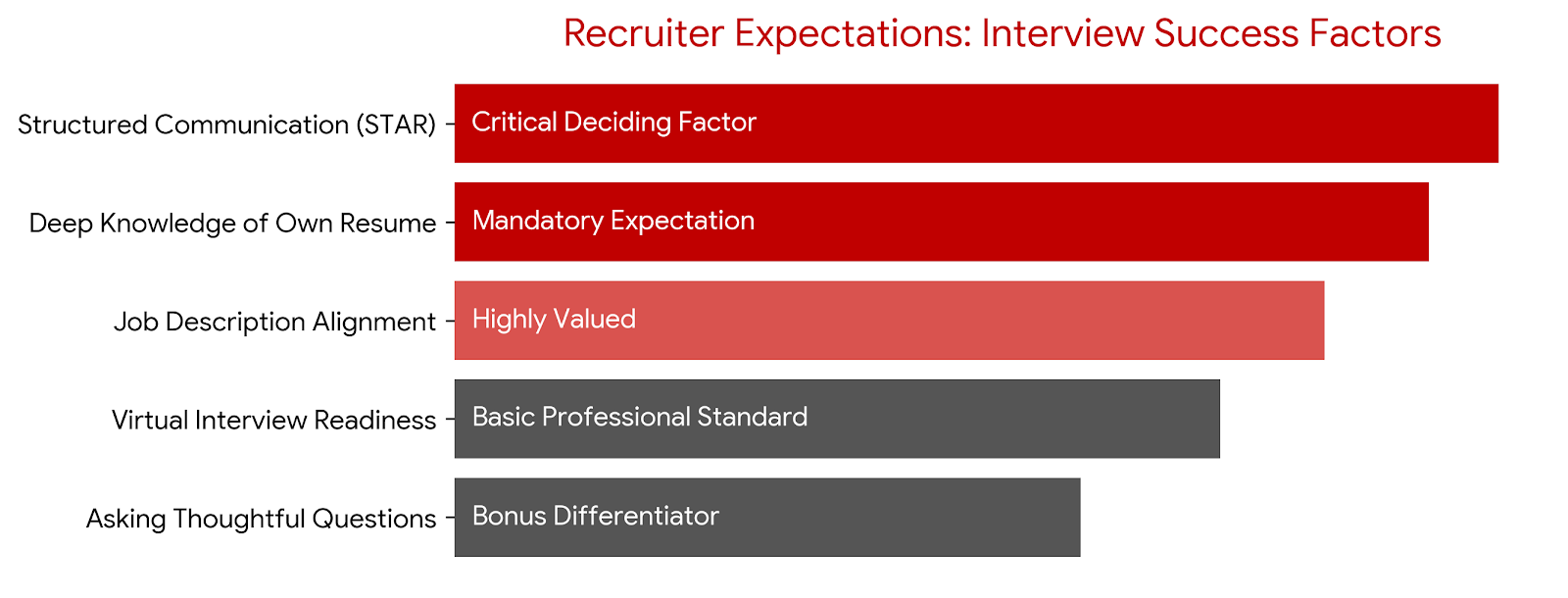
To pass, you must align your performance with what recruiters are actively seeking. The chart below ranks the priority of various interview success factors.
Deep Dive: The 7 Technical Interview Mistakes
1. Treating the Interview Like a Written Exam
Many freshers believe the goal of a coding interview is to silently write the perfect code and hand it over. This is a massive mistake. Interviewers care more about your thought process than a perfectly compiling answer.
· The 2026 Fix: Speak out loud while you think. Explain your approach before you write a single line of code.
· Wrong Mindset: “I need to know everything.”
· Right Mindset: “I can communicate clearly and learn quickly.”
2. Rambling Without Structure
When asked behavioral questions like "Tell me about a time you faced a challenge," nervous candidates often ramble for five minutes, burying the actual point of their story.
· The 2026 Fix: Master the STAR method (Situation, Task, Action, Result). Keep your answers tight, focused, and between 60 to 90 seconds long.
· Pro Tip: Pausing for 2 seconds before answering signals control and confidence, not weakness.
3. Not Knowing Your Own Resume Inside Out
If a tool or framework is on your resume, it is fair game for questioning. Freshers frequently stumble when asked to explain the specific architecture or tech stack of a project they listed.
· The 2026 Fix: Review your resume deeply. For every project, be able to clearly state the problem solved, the specific technologies used, and your exact personal contribution.
4. Relying on AI-Scripted or Robotic Answers
Using Generative AI to practice for interviews is a great strategy, but memorizing AI-generated answers word-for-word makes you sound unnatural and generic. Recruiters can instantly spot robotic phrasing.
· The 2026 Fix: Use AI as a coach to structure your thoughts, but speak using your own natural vocabulary. Authenticity always wins over a perfectly rehearsed, robotic script.
5. Faking an Answer Instead of Admitting Ignorance
You will eventually be asked a technical question you do not know the answer to. Trying to bluff your way through it, or using filler words like "basically" and "sort of," destroys your credibility.
· The 2026 Fix: Say "I don't know the exact answer to that, but here is how I would go about finding it or solving it." This shows honesty and a mature problem-solving approach.
6. Ignoring Virtual Interview Protocols
In 2026, the majority of initial technical rounds are remote. Joining late because of a software update, having poor audio quality, or looking at the screen instead of the camera signals a lack of professional preparation.
· The 2026 Fix: Test your mic, camera, and internet connection 15 minutes prior. Look directly into the camera lens to simulate eye contact, and ensure your background is clean and well-lit.
7. Having No Questions for the Interviewer
When the interviewer asks, "Do you have any questions for me?" saying "No" signals a lack of genuine interest in the company or the specific role.
· The 2026 Fix: Always prepare 2-3 thoughtful questions. Ask about the day-to-day tech stack, the engineering team's current biggest challenge, or the company's approach to integrating new technologies like AI.
Mastering Interview Prep in Pune
Knowing the mistakes is only half the battle; actively practicing how to avoid them requires a controlled environment. For graduates in Pune aiming to clear technical rounds at top IT firms, practicing in a structured setting is highly beneficial.
Programs at upGrad Learning Support Centre Pune (with locations in Kothrud and Wakad) integrate rigorous interview preparation alongside technical training.
· Live Mock Interviews: with industry experts to simulate high-pressure technical rounds.
· Portfolio Defense Practice: to ensure candidates can articulate their project architecture confidently.
· Soft Skills Coaching: to refine body language, STAR method structuring, and professional presence.
By practicing in a collaborative, instructor-led environment, freshers can eliminate interview anxiety and walk into their assessments with total confidence.
Conclusion
Technical interviews are not designed to trick you; they are designed to see how you think, communicate, and collaborate under pressure. By eliminating rambling, mastering your own resume, treating coding as a collaborative conversation, and respecting virtual protocols, you will instantly place yourself in the top percentile of applicants in 2026