
A Strategic Blueprint for Freshers and Graduates in 2026
The Gap Between College and the Corporate World
Graduating with an IT degree is a massive accomplishment, but the reality of the 2026 job market is that a degree alone rarely secures an entry-level position. Many freshers make the mistake of aggressively applying for hundreds of jobs on LinkedIn and job portals the moment they graduate, only to face automated rejections or silence.
The issue is not a lack of jobs; it is a lack of job readiness. Companies today operate in fast-paced, highly technical environments. They do not expect freshers to know everything, but they do expect a specific set of foundational skills that prove you can be trained and integrated into a real project team quickly.
Why Freshers Face Rejection (2026)
Before we look at what to learn, it is helpful to understand why applications fail. The pie chart below outlines the primary reasons freshers are rejected during technical screenings.
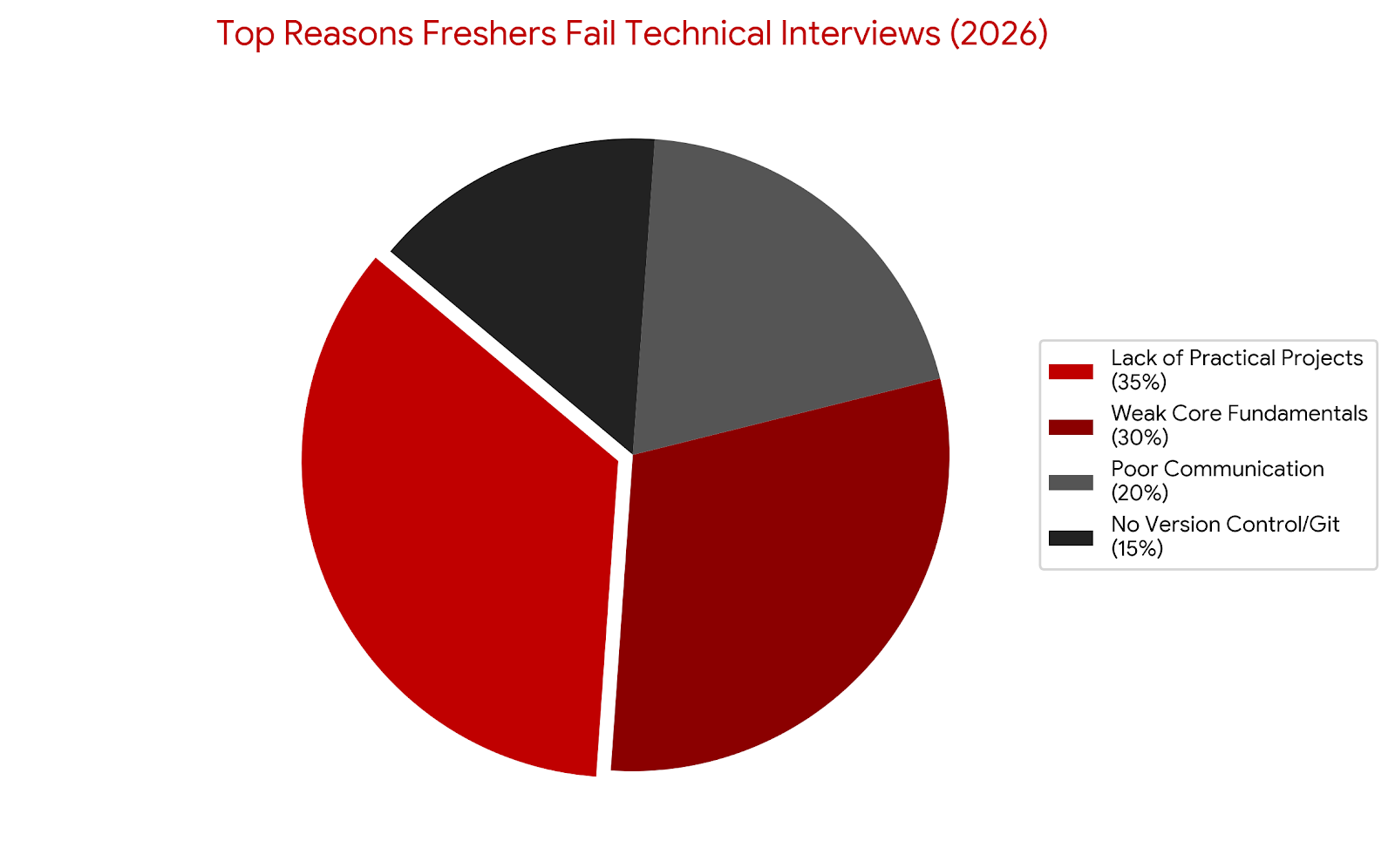
As the data suggests, recruiters are consistently filtering out candidates who lack practical evidence of their skills. Memorizing definitions will no longer cut it.
Priority Scale: What to Master Before Applying
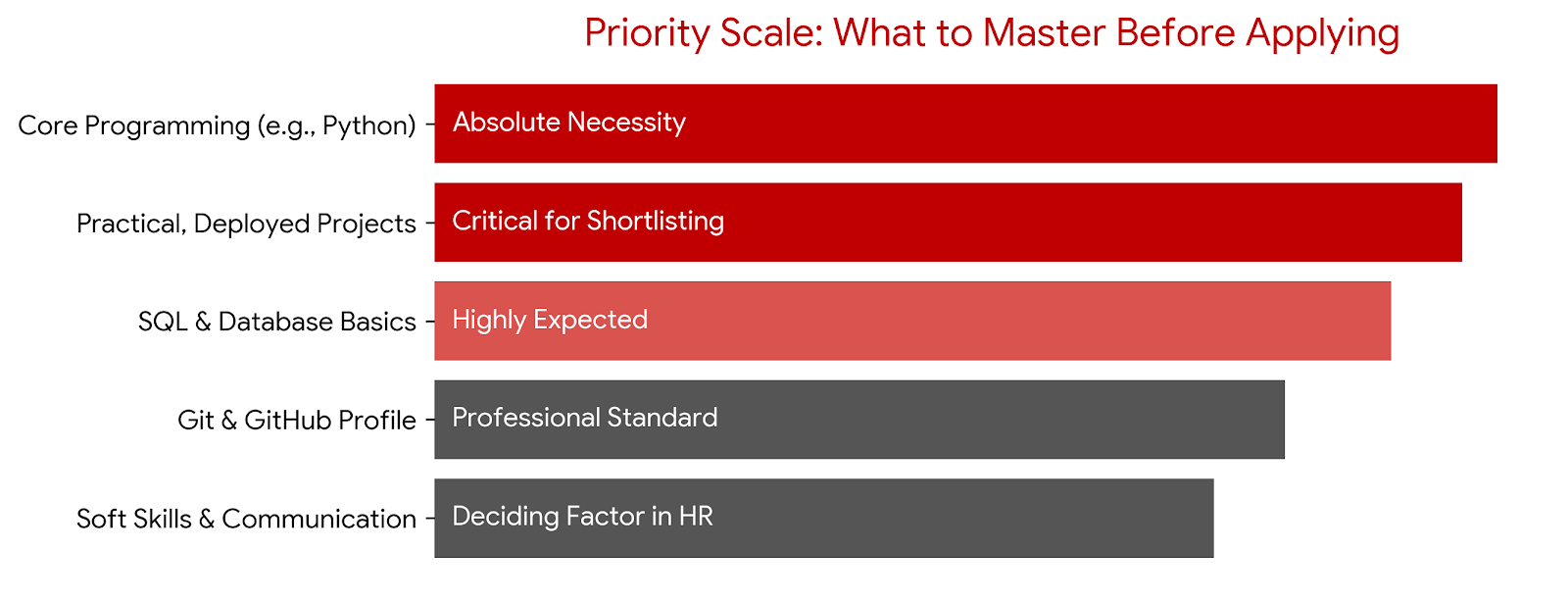
Not all skills hold equal weight in an interview. The bar chart below demonstrates the priority scale of the 5 crucial things you must learn and demonstrate before hitting the 'Apply' button.
Deep Dive: The Top 5 Things You Must Learn
1. Core Programming Fundamentals (e.g., Python or Java)
You must master at least one core programming language deeply. Instead of knowing basic syntax in five languages, focus on understanding the core logic, object-oriented programming (OOP) principles, and data structures in one. Python is highly recommended due to its versatility across data science, web backend, and automation, and its clean, readable syntax makes it an excellent foundation for understanding the joy of computing.
· Actionable Step: Avoid copying tutorials; learn to debug your own errors.
· Actionable Step: Practice algorithmic thinking daily on platforms like LeetCode or HackerRank.
2. SQL and Database Management
Almost every application built in the corporate world interacts with data. Whether you are aiming to be a software developer, a data analyst, or a QA engineer, you will need to extract, modify, and manage data.
· Actionable Step: Move beyond simple SELECT statements.
· Actionable Step: Learn how to write complex JOINs, use aggregate functions (GROUP BY), and understand basic database normalization (Primary and Foreign Keys).
3. Version Control (Git & GitHub)
In college, you write code alone. In the corporate world, you write code with dozens of other developers. Git is the system that manages these collaborative changes. Knowing how to use Git, and having a well-organized GitHub profile, proves to an employer that you understand modern development workflows.
· Actionable Step: Learn the core commands: clone, commit, push, pull, and branch.
· Actionable Step: Upload all your practice projects to GitHub and write clear, professional README files explaining what the code does.
4. Practical, Deployed Projects
A resume listing 'HTML, CSS, Python' is invisible to a recruiter. A resume linking to a live, working application proves your capability. You must build complete projects that solve a specific problem, rather than just doing minor assignments.
· Actionable Step: Build at least two substantial projects (e.g., an inventory management system, a data visualization dashboard, or an API).
· Actionable Step: Learn how to deploy them live using free tiers on platforms like Render, Vercel, or AWS.
5. Soft Skills & Business Communication
Technical skills get you the interview; communication gets you the job offer. You must be able to explain complex technical concepts simply, articulate the logic behind your code, and demonstrate that you can work well within a team.
· Actionable Step: Practice speaking out loud while writing code to simulate technical interviews.
· Actionable Step: Learn how to write professional emails and format a clean, ATS-friendly resume.
The Pre-Application 90-Day Sprint
If you realize you are missing some of these crucial skills, pause your job applications and execute this 90-day sprint:
Phase 1: Skill Audit & Fundamentals (Days 1–30)
Identify your weak points. Spend this month mastering your core language (Python/Java) and deeply understanding SQL concepts. Set up your GitHub account.
Phase 2: Project Development (Days 31–60)
Stop watching courses. Build two end-to-end projects. Push the code to GitHub daily to show a consistent commit history. Ensure the projects utilize a database.
Phase 3: Deployment & Polish (Days 61–90)
Deploy your projects so they are accessible via a web link. Update your resume to feature these links at the top. Conduct mock interviews focusing on communicating your project logic.
Accelerating Your Career Preparation in Pune
For graduates located in Pune—a major hub for IT services and product companies—preparing for these interviews requires a highly structured approach. Self-learning can sometimes leave blind spots, especially when it comes to understanding exactly what local recruiters are looking for.
For freshers who prefer a professional, instructor-led environment, upGrad Learning Support Centre Pune offers highly specialized, classroom-based programs. With accessible centers in Kothrud and Wakad, upGrad provides training that perfectly aligns with these top 5 industry requirements.
· Expert-led technical training to master Python, Java, Data Science, or Full Stack Development.
· Guided, live projects that build a robust, interview-ready GitHub portfolio.
· Dedicated career services and mock interviews designed to refine your soft skills and communication before you face real HR managers.
By leveraging a collaborative peer environment, freshers can confidently bridge the gap between their college degree and their first corporate IT job.
Frequently Asked Questions
Is Python a good language to learn first?
Yes, it is highly recommended. Python's clear syntax allows you to focus on the core joy of computing and algorithmic logic without getting bogged down in complex boilerplate code. It is also the industry standard for Data Science and AI.
Do I need to learn AWS or Cloud before applying?
While basic cloud awareness is helpful, mastering core programming, SQL, and Git is much more important for a fresher. Companies expect to teach you their specific cloud infrastructure on the job.
How many projects should I have on my resume?
Quality beats quantity. Two highly detailed, well-documented, and fully deployed projects are far better than ten unfinished or copied tutorial projects.
Conclusion
The rush to apply for jobs immediately after graduation often leads to burnout and rejection. Take a step back. Master your core programming language, get comfortable with SQL and Git, build real projects, and learn how to communicate your technical choices. By treating your job preparation as a 90-day intensive project, you will transition from just another applicant to a highly sought-after IT professional.