A Strategic Guide to Launching Your Tech Career
The Post-Graduation Tech Landscape
Completing your graduation is a major milestone, but stepping into the 2026 IT job market requires a highly targeted approach. The industry has moved away from hiring candidates with broad, generic knowledge. Instead, recruiters are actively looking for specialists—freshers who possess deep, practical expertise in a specific domain.
Choosing the right IT course immediately after graduation can save you months of trial and error. A specialized course provides a structured curriculum, hands-on projects, and the exact tech stack that modern enterprises use. Below, we break down the top 5 IT courses that offer the highest return on time invested for freshers this year.
Market Demand Breakdown (2026)
To make an informed decision, it is essential to understand where the current entry-level hiring demand lies. The pie chart below illustrates the approximate distribution of fresher hiring across major IT domains.
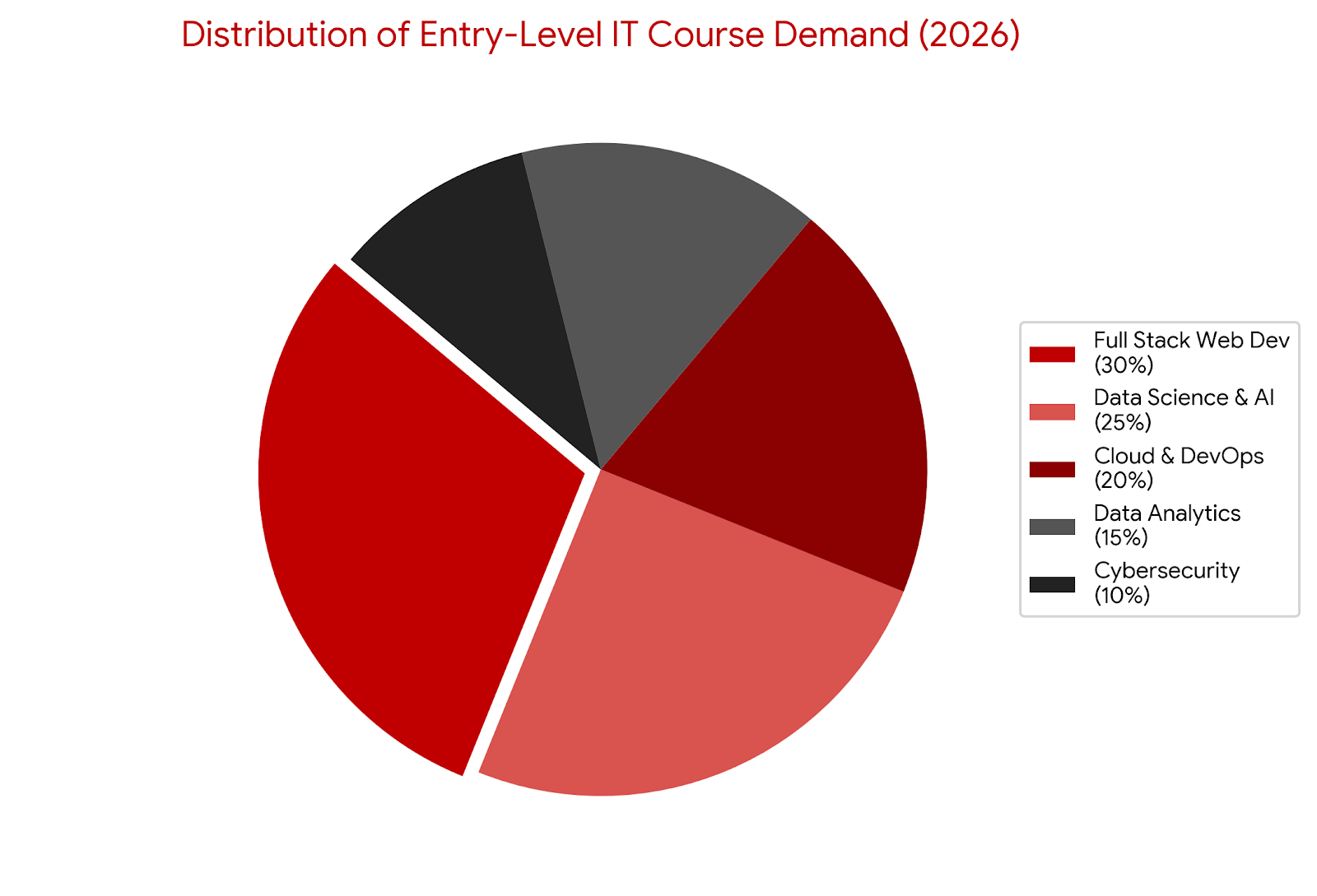
Note: While Full Stack Development continues to hold the largest share of entry-level jobs, Data Science and Cloud Computing are seeing the fastest year-over-year growth.
Top 5 IT Courses Demand Guide
Beyond raw distribution, understanding the specific industry demand and hiring urgency for each specialization is key. The guide below highlights how companies prioritize these top 5 skills.
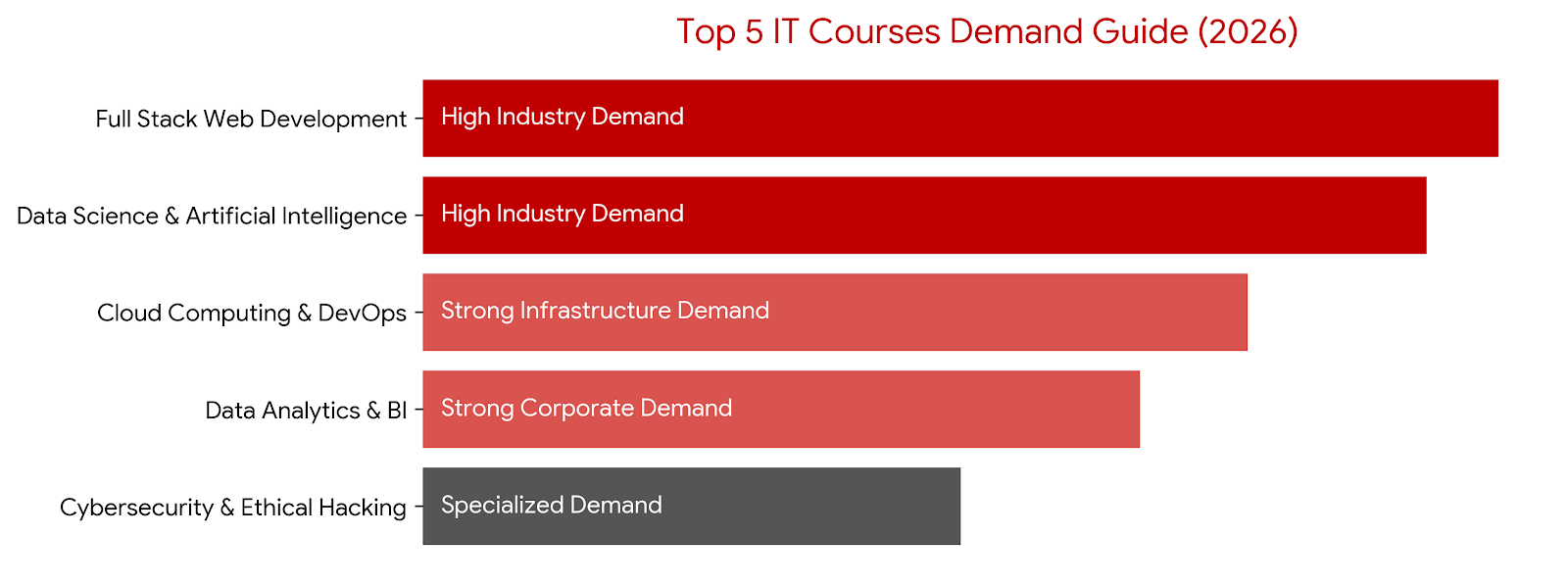
The Top 5 IT Courses for Graduates
1. Full Stack Web & Application Development
A Full Stack Development course transforms a graduate into a versatile engineer capable of handling both user interfaces (frontend) and server logic (backend).
· What You Learn: React, Angular, or Vue.js for dynamic frontends.
· What You Learn: Node.js, Express, or Java Spring Boot for robust backends.
· What You Learn: MongoDB or PostgreSQL for database management.
· Target Roles: Software Developers, Web Application Engineers, UI/UX Integrators.
2. Data Science & Artificial Intelligence (AI)
Data Science is the art of extracting business value from raw data. With AI being integrated into every product in 2026, courses in this domain are highly lucrative.
· What You Learn: Python programming and Pandas for data manipulation.
· What You Learn: Machine Learning algorithms and predictive modeling.
· What You Learn: Generative AI basics (LLMs, API integrations, and Prompting).
· Target Roles: Data Scientist Trainee, Machine Learning Junior Engineer, AI Analyst.
3. Cloud Computing & DevOps
Companies have migrated their infrastructure to the cloud. This course focuses on how to deploy, monitor, and scale software applications seamlessly.
· What You Learn: AWS, Microsoft Azure, or Google Cloud fundamentals.
· What You Learn: Linux administration and networking basics.
· What You Learn: Docker containerization and CI/CD automation pipelines.
· Target Roles: Junior Cloud Engineer, DevOps Associate, Site Reliability Trainee.
4. Data Analytics & Business Intelligence
For graduates who prefer a less programming-heavy route while still working in high tech, Data Analytics is the perfect bridge between technology and business strategy.
· What You Learn: Advanced Microsoft Excel and descriptive statistics.
· What You Learn: SQL for complex database querying.
· What You Learn: Power BI or Tableau for creating interactive corporate dashboards.
· Target Roles: Business Analyst, Data Analyst, BI Reporting Executive.
5. Cybersecurity & Ethical Hacking
As digital footprints expand, protecting data is paramount. A cybersecurity course trains graduates to think like hackers to secure enterprise systems.
· What You Learn: Network protocols and vulnerability assessments.
· What You Learn: Penetration testing and risk mitigation strategies.
· What You Learn: Security compliance and identity access management.
· Target Roles: Security Analyst Trainee, Network Defense Associate.
Course Comparison Matrix
Use this matrix to align your personal strengths with the right technical path:
|
Course Domain |
Primary Focus |
Ideal Candidate Profile |
|
Full Stack Dev |
Building functional software |
Loves coding, building things from scratch, and visual results. |
|
Data Science & AI |
Predictive models & logic |
Strong in mathematics, enjoys algorithms and problem-solving. |
|
Cloud & DevOps |
Deployment & infrastructure |
Prefers fixing systems, servers, and automating processes. |
|
Data Analytics |
Insights & reporting |
Highly analytical, enjoys business strategy and visual charts. |
|
Cybersecurity |
Protection & defense |
Detail-oriented, interested in networks, and naturally curious. |
The 90-Day Sprint to Job Readiness
Instead of a long, drawn-out roadmap, many specialized courses focus on a rigorous 90-day sprint. Here is how you should structure your time after graduation:
Phase 1: Foundation (Days 1–30)
Dedicate your first month entirely to syntax and core principles. Do not touch advanced frameworks. If you are learning Python, master loops and object-oriented concepts. If you are learning Cloud, master basic networking and Linux commands.
Phase 2: Frameworks & Tools (Days 31–60)
Once the foundation is rock solid, introduce industry tools. This is where you learn React, Power BI, Docker, or Pandas. Combine these tools with Git/GitHub to start version-controlling your practice code.
Phase 3: Portfolio & Preparation (Days 61–90)
Stop watching tutorials. Spend the final 30 days building two original projects. Concurrently, optimize your LinkedIn profile and begin practicing mock technical interviews specific to your course domain.
Accelerating Your Career in Pune
Pune is one of India's leading IT hubs, making it an excellent city for fresh graduates to launch their careers. However, bridging the gap between a university degree and an IT job often requires structured mentorship.
For graduates looking for a professional, classroom-based environment, upGrad Learning Support Centre Pune offers highly specialized programs. With accessible centers in Kothrud and Wakad, upGrad provides instructor-led training in high-demand fields like Full Stack Development, Data Science, and Data Analytics.
The benefit of learning through a dedicated center includes:
· In-person instructor support to resolve complex coding doubts instantly.
· Guided, live projects that simulate real corporate work environments.
· Dedicated career services, including resume optimization and interview coaching.
By stepping out of isolated online learning and entering a collaborative peer environment, graduates can significantly accelerate their job readiness.
Frequently Asked Questions
Can non-IT graduates transition into these courses?
Yes. Courses like Data Analytics and Full Stack Development are highly accessible to non-IT graduates who are willing to put in the effort to learn the foundational logic.
Which course has the highest starting salary?
Data Science and AI roles typically offer premium entry-level salaries, though Full Stack Development provides the highest volume of available jobs.
Are certifications enough to get hired?
Certifications get your resume read, but practical projects and interview performance get you the job offer.
Conclusion
Graduating in 2026 offers immense opportunities if you align your skills with market demand. Do not try to learn everything at once. Pick one of the top 5 courses—Full Stack, Data Science, Cloud, Analytics, or Cybersecurity—and dive deep. Leverage structured learning environments, build a portfolio of real-world projects, and transition confidently from a graduate to a tech professional.