
A Hands-On Portfolio Guide to Passing Technical Screenings
Why Static Resumes Fail in 2026
In the current hiring landscape, submitting a resume that simply lists technical keywords like Python, React, and SQL is no longer sufficient. Recruiters and engineering hiring managers evaluate hundreds of applicants daily and look for tangible proof that a fresher can build, debug, and ship production-quality code.
Building 2 to 3 substantive, deployed projects provides undeniable evidence of competence. A live project demonstrates that you understand application architecture, database schema design, modern version control workflows, and cloud deployment pipelines. Instead of copying cookie-cutter tutorial code, freshers need projects that solve real problems and clearly showcase their independent technical thinking.
Fresher Resume Shortlisting Breakdown (2026)
Technical recruiters evaluate multiple facets of a project when reviewing an entry-level applicant. The pie chart below highlights the distribution of what technical screeners look for in fresher portfolios.
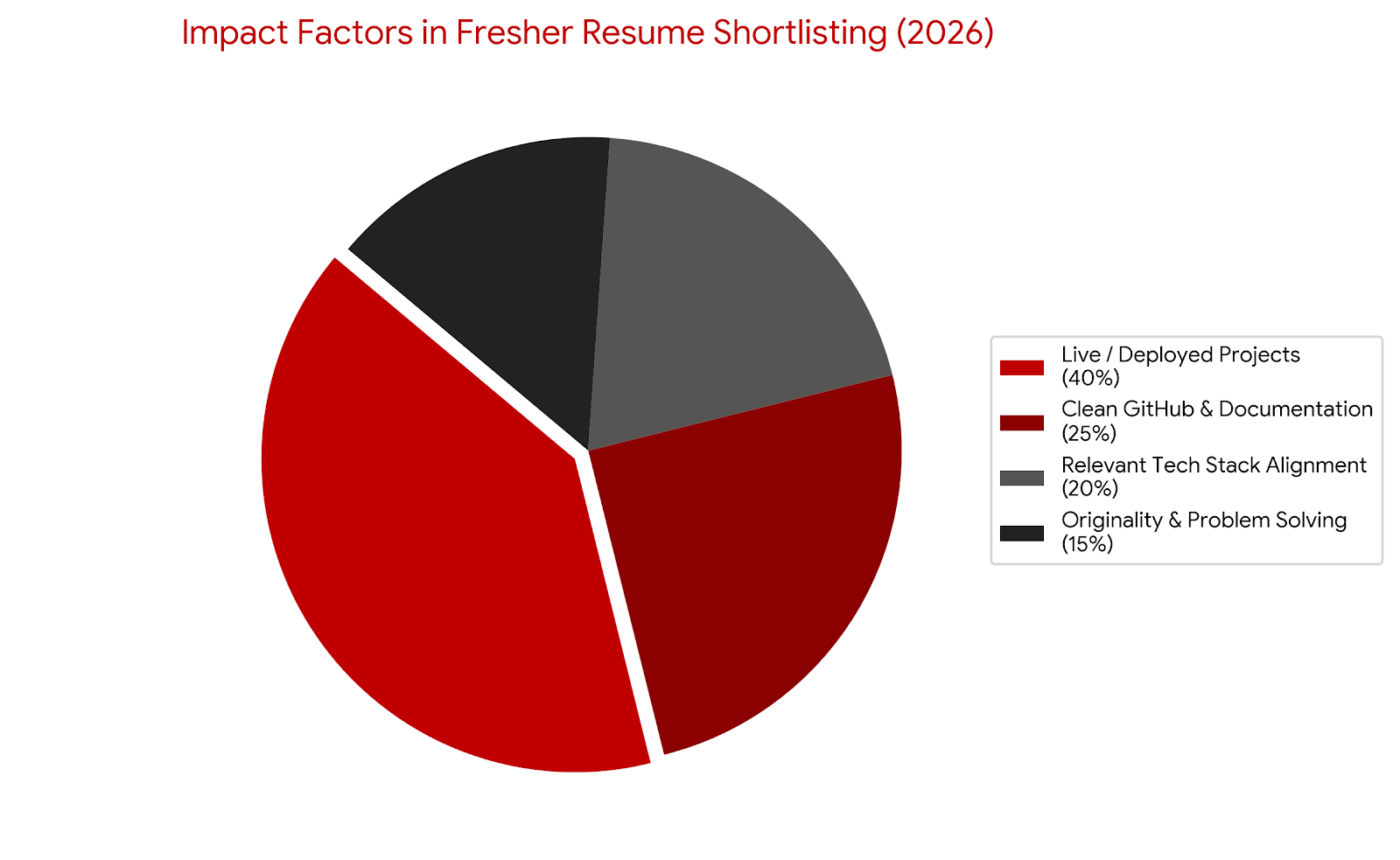
Note: A live, accessible deployment holds the single highest weight because it allows hiring managers to evaluate functionality within seconds without cloning local repositories.
Recruiter Value by Project Category
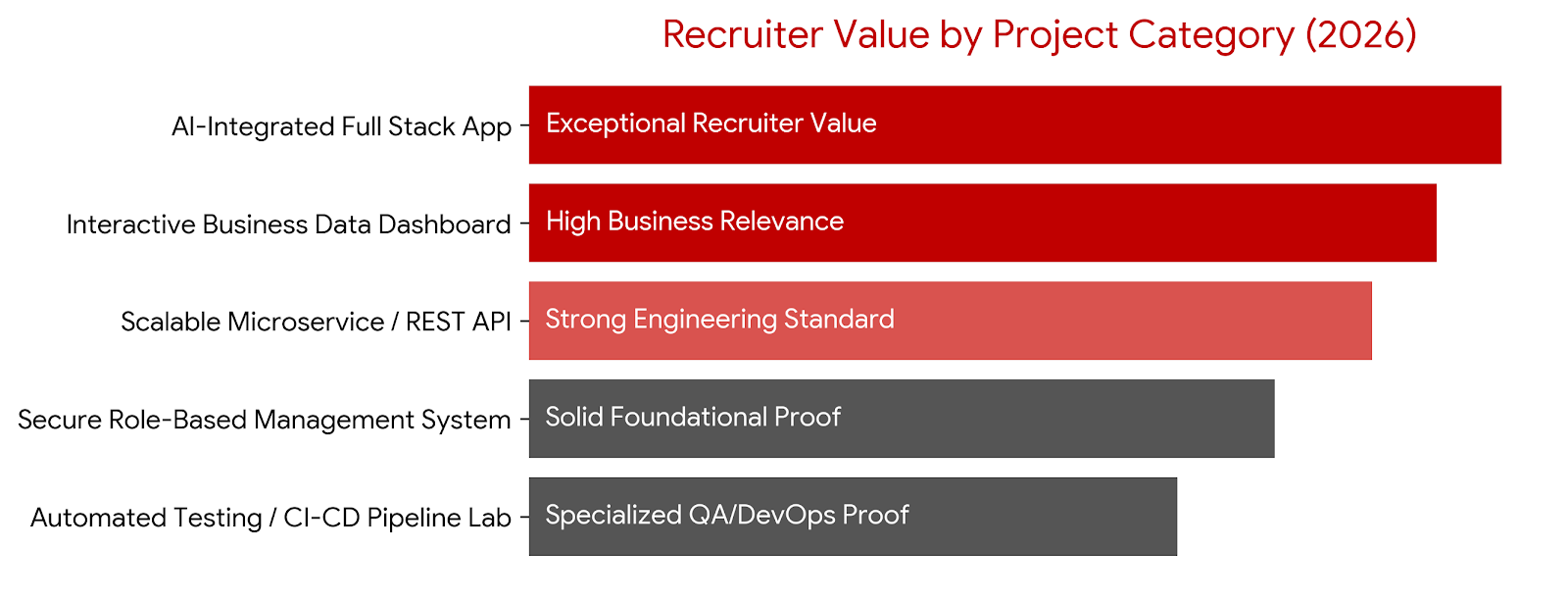
Not every project carries equal weight during screening. The priority scale below ranks different project types based on industry relevance, complexity, and employer demand in 2026.
Deep Dive: Top 5 Practical Projects to Build
1. AI-Integrated SaaS Web Application
Modern software engineering heavily incorporates intelligent automation. Building a web application that connects frontend interactivity with backend APIs and integrates an LLM (such as OpenAI's API or open-source Hugging Face endpoints) instantly sets your profile apart.
· Recommended Tech Stack: React or Next.js for frontend, Node.js or Python FastAPI for backend, PostgreSQL for data storage, and external AI APIs.
· Real-World Example: AI-powered resume analyzer, smart customer support ticket summarizer, or automated content generator.
· Target Job Roles: Full Stack Developer, Junior Software Engineer, AI Application Developer.
2. End-to-End Business Intelligence & Data Dashboard
For candidates pursuing data-oriented careers, showcasing raw CSV manipulation is not enough. You need an end-to-end data pipeline that extracts data, cleans it, loads it into an optimized relational database, and exposes interactive executive metrics.
· Recommended Tech Stack: Python (Pandas), SQL (MySQL or PostgreSQL), Power BI or Streamlit, and GitHub for data versioning.
· Real-World Example: E-commerce sales performance analytics, regional hospital patient intake tracker, or financial fraud anomaly dashboard.
· Target Job Roles: Data Analyst, Business Intelligence Developer, Junior Data Engineer.
3. Scalable Microservice REST API with JWT Authentication
Backend engineering roles require a firm grasp of API architecture, data security, and efficient query structuring. Building a standalone, well-documented RESTful API proves that you understand backend mechanics without relying on UI templates.
· Recommended Tech Stack: Java Spring Boot or Python FastAPI/Django, Redis for caching, PostgreSQL, and Swagger/OpenAPI documentation.
· Real-World Example: High-concurrency booking service, digital wallet transaction API, or multi-tenant user authentication microservice.
· Target Job Roles: Backend Engineer, Java Developer, API Integration Specialist.
4. Role-Based Management System (E-Commerce or ERP)
A comprehensive role-based access control (RBAC) application demonstrates your ability to model real-world business logic. It shows you can separate administrative privileges from customer interfaces and safely handle transactions.
· Recommended Tech Stack: MERN Stack (MongoDB, Express, React, Node.js) or Python/Django with PostgreSQL, integrated with Stripe/Razorpay test gateways.
· Real-World Example: College placement management portal, multi-vendor marketplace, or medical clinic appointment manager.
· Target Job Roles: Full Stack Web Developer, Enterprise Application Trainee.
5. Automated Testing & Containerized CI/CD Pipeline
Employers value candidates who understand reliability and modern deployment practices. Building a small web service, writing thorough unit/integration tests, containerizing it with Docker, and pushing it through a GitHub Actions CI/CD pipeline signals mature engineering discipline.
· Recommended Tech Stack: Python or JavaScript, Selenium or PyTest, Docker, and GitHub Actions deploying to AWS or Render.
· Real-World Example: Automated regression testing suite for an e-commerce checkout flow with automatic build verification on every commit.
· Target Job Roles: QA Automation Engineer, Junior DevOps Associate, Cloud Support Engineer.
Project Selection Matrix for Freshers
Choose projects that reinforce your target specialization rather than building unrelated applications:
|
Target Career Track |
Primary Recommended Project |
Key Recruiter Evaluation Metric |
|
Full Stack Development |
AI-Integrated Web App / RBAC System |
Code cleanliness, API integration, deployment stability. |
|
Data Analytics / Science |
End-to-End Business Dashboard |
SQL query complexity, dashboard interactivity, actionable insights. |
|
Backend & Cloud |
Microservice REST API with Docker |
Database normalization, JWT security, documentation via Swagger. |
|
QA & Automation |
Automated Testing Pipeline |
Test coverage, defect identification, CI/CD automation. |
The 90-Day Portfolio Sprint
Building professional-grade projects takes methodical planning. Follow this structured 3-phase execution timeline:
Phase 1: Architecture & Data Modeling (Days 1–30)
Select your primary specialization. Outline user stories, draw database relationship diagrams (ERDs), and set up your repository with clear branch protection rules.
Phase 2: Core Development & Database Integration (Days 31–60)
Implement backend logic, build responsive frontend views, and handle input validation and error states gracefully. Commit code daily to demonstrate consistent progress.
Phase 3: Deployment, Documentation & Testing (Days 61–90)
Deploy your application to a public cloud tier. Write a comprehensive README complete with architecture diagrams, setup instructions, and live credentials. Record a 2-minute Loom demonstration.
Building Industry-Ready Projects in Pune
Pune has established itself as one of the country's most vibrant technical corridors, home to global IT consultancies, mid-sized product firms, and fast-growing tech startups. However, transitioning from academic theory to corporate-grade projects can be challenging in isolation.
For students and graduates who prefer structured, classroom-based learning, upGrad Learning Support Centre Pune offers dedicated training programs. With accessible centres in Kothrud and Wakad, upGrad provides hands-on curriculums covering Full Stack Development, Data Science, Data Analytics, and AI.
· Direct faculty mentorship to guide you through system architecture and debugging complex code blockers.
· Industry-grade live projects that match current IT enterprise workflows rather than outdated academic syllabi.
· Career support services helping freshers build compelling GitHub portfolios and master technical interview discussions.
Learning alongside peers in a physical tech lab provides the accountability and structure needed to build genuine portfolio assets.
Frequently Asked Questions
How many projects should I feature on my fresher resume?
Feature two or three deep, complete, and live projects. Having two well-documented projects where you can discuss architecture and challenges is far superior to listing ten basic tutorial clones.
Do I need to pay for cloud hosting to deploy projects?
No. You can leverage generous free tiers on platforms like Render, Vercel, Supabase, and AWS Free Tier to host both frontends, backends, and databases.
Is copying YouTube project tutorials acceptable?
Recruiters quickly recognize generic tutorial projects. You can use tutorials to learn fundamentals, but your resume projects must have unique features, custom schemas, and personal problem statements.
Conclusion
In the competitive 2026 fresher market, practical proof is your strongest differentiator. By investing the time to construct, document, and deploy two or three substantial projects, you prove that you have already bridged the gap between academic theory and software engineering. Pick a domain, start architecting, and turn your portfolio into your most powerful job-seeking asset.