Your first IT job interview can feel like the biggest exam of your life — except there's no fixed syllabus, and the panel is judging far more than just your technical knowledge. That mix of pressure and uncertainty is exactly why so many freshers walk in underprepared, not because they lack ability, but because they never had a structured plan to prepare.
The good news is that interview preparation is a learnable process. It isn't about memorising answers; it's about covering the right areas, in the right order, with enough practice that you can stay calm when it actually matters.
This checklist walks you through everything an IT fresher should do before, during, and after a first job interview in 2026 — from researching the company to following up afterward — with practical examples, comparison tables, and visuals you can actually use.
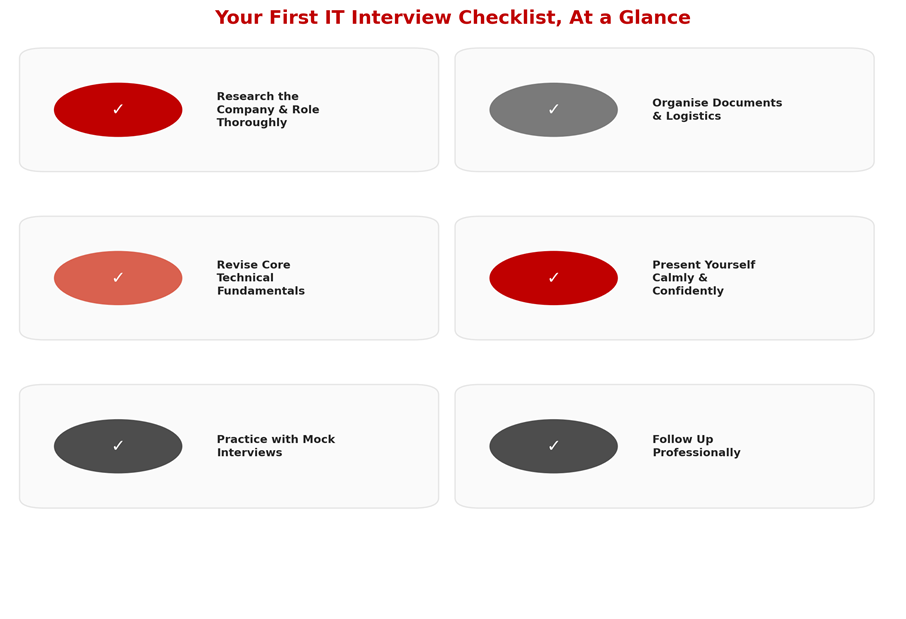
The six broad phases of interview preparation covered in this guide.
Why First Interview Preparation Matters More in 2026
Hiring for entry-level IT roles in 2026 increasingly involves multiple rounds — an online assessment, a technical round, and a separate HR or culture-fit round — sometimes conducted virtually and sometimes in person. Many companies also use AI-assisted tools to screen or shortlist candidates before a human interviewer ever gets involved.
That means preparation can't be limited to “revising a few coding questions the night before.” Interviewers are evaluating how you think, how clearly you communicate, and how you handle a question you don't immediately know the answer to — alongside your technical fundamentals.
Your IT Fresher Interview Prep Timeline
Use the timeline below as a pacing guide. If your interview is scheduled sooner, compress each stage proportionally rather than skipping steps entirely.
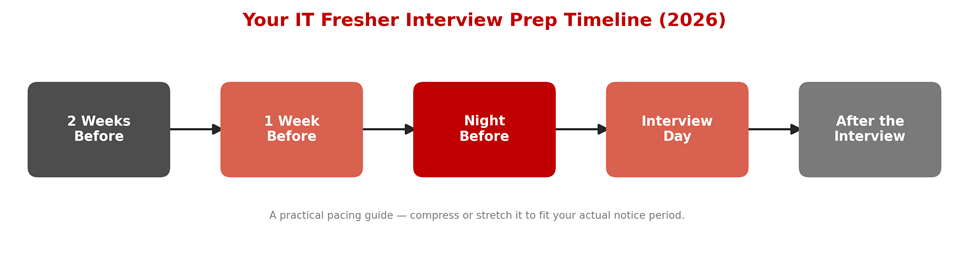
A five-stage pacing guide from two weeks out through your follow-up.
Two Weeks Before: Research and Fundamentals
• Read the company's website, product pages, and recent news or blog posts to understand what they build and why.
• Identify the specific tech stack mentioned in the job description and revise the fundamentals behind each one.
• Look up the interview process or format shared publicly on platforms like Glassdoor or LinkedIn, if available.
• Revise core CS fundamentals relevant to your role: data structures, OOP concepts, DBMS basics, and networking essentials.
One Week Before: Practice and Mock Interviews
• Solve coding problems relevant to the role's tech stack regularly, rather than cramming everything in the final days.
• Do at least two to three mock interviews with a friend, senior, or mentor; record yourself if possible to review pacing and body language.
• Prepare four to five detailed project or internship stories using a simple Situation-Task-Action-Result (STAR) structure.
• Rehearse answers to common HR questions in your own words — avoid memorising a script that ends up sounding robotic.
The Night Before: Logistics and Materials
• Keep printed or digital copies of your resume, ID proof, and any offer or reference documents you may need ready.
• Confirm the interview mode (in-person, phone, or video call), and test your internet, camera, and microphone if it's virtual.
• Plan your travel route and timing for an in-person interview, or double-check the video call link and login details.
• Lay out your clothes and pack your bag the night before so the morning of the interview stays calm and unhurried.
Interview Day: Presentation and Mindset
• Dress in neat, professional attire suited to the company's culture — when in doubt, smart formal is a safe default.
• Arrive, or log in, 10–15 minutes early to settle your nerves and avoid a rushed start.
• Maintain steady eye contact, a calm tone, and open body language throughout the conversation.
• If you don't know an answer, say so honestly and talk through your reasoning instead of guessing randomly.
After the Interview: Follow-Up That Matters
• Send a short, polite thank-you email within 24 hours, referencing one specific point from the conversation.
• Note down the questions you found difficult so you can prepare better for future interviews.
• Follow up politely if you haven't heard back within the timeline the recruiter mentioned, rather than messaging repeatedly.
What Interviewers Are Actually Evaluating in a Fresher
Freshers often assume interviews are purely a technical test, but most interviewers are weighing several things at once — including how you communicate and how you handle pressure, not just whether you know the “right” answer.
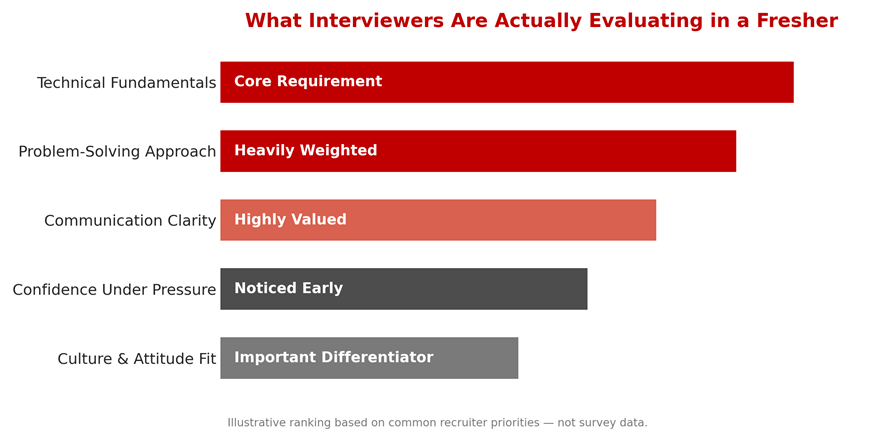
Beyond raw technical knowledge, these factors shape how a fresher is evaluated.
This is exactly why two candidates with similar technical knowledge can get very different outcomes: the one who explains their thought process clearly and stays composed usually comes across as more hireable, even if their final answer wasn't perfect.
Suggested Prep-Time Split for Your Final Week
A common mistake is spending the entire final week only revising coding problems while ignoring mock interviews and company research. The suggested split below balances all three, along with rest.
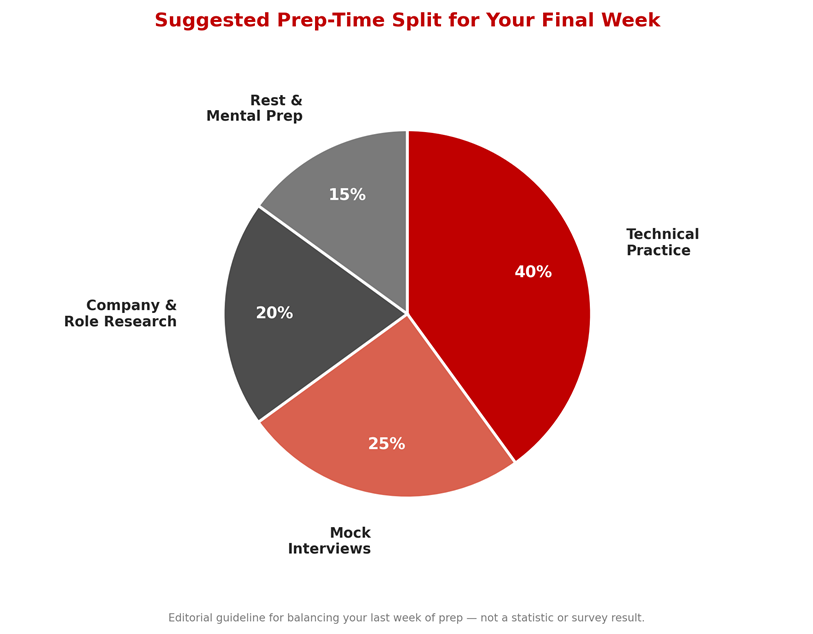
Notice that rest and mental preparation get a deliberate share too. Walking into an interview exhausted from last-minute cramming often does more damage than the extra hour of revision helps.
“Tell Me About Yourself” — What Works and What Doesn't
This is almost always the opening question, and it sets the tone for the rest of the interview. A generic answer makes you forgettable; a specific one gives the interviewer something concrete to follow up on.
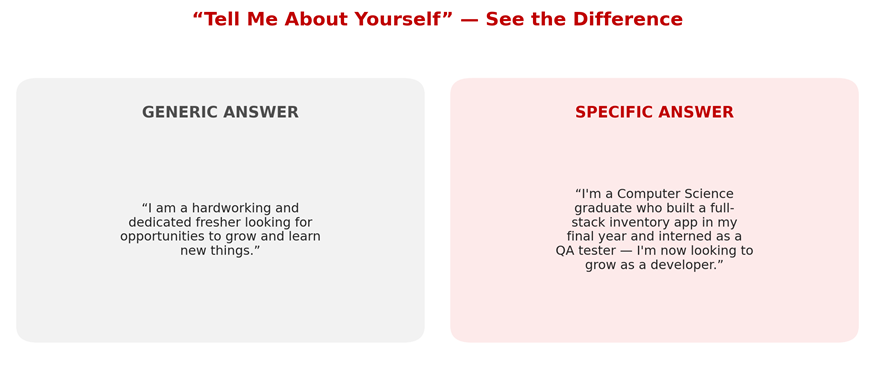
The same question, answered in a way that fades vs. a way that's memorable.
Keep your answer to about 60–90 seconds, structured as: who you are academically, one or two concrete achievements (a project or internship), and what you're looking for next. Avoid reciting your entire resume line by line.
Technical Round vs. HR Round: What to Expect
|
Aspect |
Technical Round |
HR / Behavioural Round |
|
Primary focus |
Problem-solving, coding, core CS concepts |
Communication, attitude, culture fit |
|
Common format |
Live coding, whiteboard or online editor, concept Q&A |
Conversational Q&A, behavioural questions |
|
What to prepare |
DSA basics, your projects, tech-stack fundamentals |
Self-introduction, strengths/weaknesses, company research |
|
Key tip |
Explain your thought process out loud, even if stuck |
Be honest and specific; avoid rehearsed-sounding scripts |
Interview Do's and Don'ts at a Glance
|
Situation |
Do |
Don't |
|
Facing a tough question |
Think aloud and attempt a structured approach |
Stay silent or guess randomly without explanation |
|
Talking about weaknesses |
Mention a real weakness plus a step you're taking to improve it |
Claim to have “no weaknesses” |
|
Discussing a past mistake |
Explain what happened and what you learned from it |
Blame teammates, circumstances, or bad luck |
|
Salary discussion |
Give a brief, researched range if asked directly |
Avoid the question entirely, or demand a figure with no research |
|
Ending the interview |
Ask a thoughtful question about the role or team |
Say “no questions” out of habit, every single time |
How Structured Preparation Support Can Help You Walk in Confident
Reading a checklist is useful, but nothing replaces practising out loud, getting feedback on your answers, and having someone point out habits you can't see in yourself.
At upGrad Learning Support Centre, Pune, learners preparing for entry-level IT roles get access to mentor-guided project work, structured skill-building, and interview preparation support — including practising the kind of technical and behavioural questions covered in this guide. For freshers, having a mentor review a mock interview or a project explanation often catches gaps that are hard to spot alone.
If you're building toward your first IT interview, combining a checklist like this with structured, guided practice can help turn preparation into genuine confidence on the day.
Get Regular Job Updates
Looking for regular IT job updates, fresher opportunities, and career-related updates? Join our WhatsApp group for more job updates and opportunities.
Join our WhatsApp Group: https://chat.whatsapp.com/KA8HpgjbJ67I5yfQDquCvn
Frequently Asked Questions (FAQs)
Q: How should freshers answer “Tell me about yourself” in an IT interview?
Keep it to about 60–90 seconds: briefly cover your academic background, highlight one or two concrete projects or achievements, and end with what you're looking for next. Avoid simply repeating your resume line by line.
Q: How many mock interviews should a fresher do before the real one?
Two to three focused mock interviews are usually enough if you review and improve after each one. More matters less than actually acting on the feedback you receive.
Q: What should freshers wear for an IT job interview in 2026?
Smart formal or business casual is a safe default for most IT companies, whether the interview is in person or virtual. When unsure, it's better to be slightly overdressed than too casual.
Q: Is it okay to say “I don't know” during a technical round?
Yes — honesty is better than guessing randomly. Say you're not sure, then walk through how you'd approach finding the answer; interviewers often value the reasoning process as much as the final answer.
Q: Should freshers negotiate salary in their first job interview?
You can share a researched, reasonable expectation if asked directly, but aggressive negotiation is uncommon for entry-level roles. Focus on demonstrating value first; compensation conversations usually follow once there's mutual interest.
Q: How long should a fresher's self-introduction be?
Around 60–90 seconds is ideal — long enough to cover the essentials, short enough to hold attention and leave room for follow-up questions.
Q: What documents should a fresher carry to an interview?
Carry a few printed copies of your resume, a valid photo ID, your academic mark sheets or certificates if requested, and any offer or experience letters relevant to the role.
Q: How soon should you send a thank-you email after an interview?
Within 24 hours is ideal. Keep it short, mention one specific point from the conversation, and reaffirm your interest in the role.
Conclusion
Your first IT interview doesn't need to feel like a gamble. Most of what determines the outcome — researching the company, revising fundamentals, practising out loud, and staying composed under pressure — is entirely within your control if you start early enough.
Work through the timeline in this guide one stage at a time, use the checklist as your final review, and remember that interviewers are evaluating your thinking and communication just as much as your technical knowledge. Combine that preparation with structured support — through mentor-guided practice at upGrad Learning Support Centre, Pune, or through consistent self-practice — and you'll walk into your first interview genuinely ready.